
Teaching · Title of Christ
A Ransom for Many
Jesus' own words about his death (Mark 10:45)
Jesus said that his life would be given as a ransom for many. A ransom is what you pay to buy a captive's freedom; his death was that price, paid to free sinners from sin.
What a ransom is
In the ancient world a ransom was money paid to buy a slave his freedom or a prisoner his release. The Old Testament law let a man redeem a relative who had sold himself (Leviticus 25:47–49), and spoke of a price paid in place of a life (Exodus 21:30). The idea was always the same: someone pays, and someone goes free.
Jesus' words
When James and John asked for the best seats in his kingdom, Jesus told the disciples that greatness means serving, and then explained why he had come: "to give his life a ransom for many" (Mark 10:45; Matthew 20:28). He did not die as a helpless victim. He died on purpose, paying what we could not pay. Paul says the same with a wider word: Christ "gave himself a ransom for all" (1 Timothy 2:6), and Peter reminds his readers that they were bought not with silver or gold but with the precious blood of Christ (1 Peter 1:18–19).
For us
Sin held us as a debt we could never clear and a master we could not escape. The ransom has been paid in full. Those who trust Jesus are free, and they belong to him who bought them.
Key verses
- Mark 10:45
For even the Son of man came not to be ministered unto, but to minister, and to give his life a ransom for many.
- Matthew 20:28
Even as the Son of man came not to be ministered unto, but to minister, and to give his life a ransom for many.
- 1 Timothy 2:6
Who gave himself a ransom for all, to be testified in due time.
- 1 Peter 1:18–19
Forasmuch as ye know that ye were not redeemed with corruptible things, as silver and gold, from your vain conversation received by tradition from your fathers; But with the precious blood of Christ, as of a lamb without blemish and without spot:
Read next
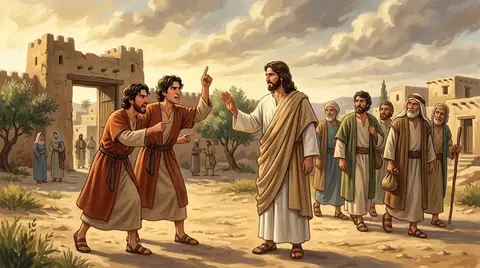 Person · ApostleJamesThe fisherman son of Zebedee, brother of John and one of Jesus' three closest disciples. Jesus called the brothers…
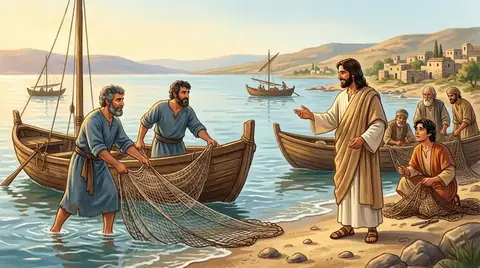 PersonJohnThe fisherman who became "the disciple whom Jesus loved". Youngest of the twelve, he stood at the cross, ran to the…
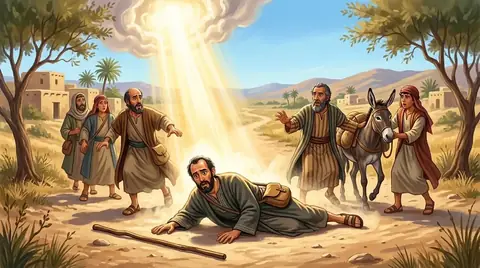 PersonPaulA Pharisee who hated the church until the risen Jesus met him on the road to Damascus. He became the apostle to the…
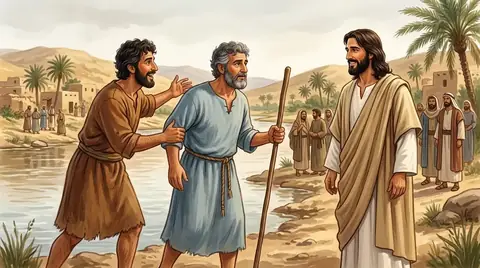 PersonPeterA Galilean fisherman who became the leader of the twelve apostles. Bold and impulsive, he confessed Jesus as the…
Written for this app in its own words, from the Bible, with the facts checked against Bible dictionaries and encyclopedias: Easton's, Smith's, Fausset's, ISBE, Holman, the New Bible Dictionary, Vine's and the Thompson Chain topics.
