
Group
Zealots
Jews burning to throw off Roman rule, some by force of arms. Simon, one of the twelve apostles, is called "the Zealot".
- Where
- Luke 6:15; Acts 1:13; Acts 5:37; also Matthew 10:4; Mark 3:18
- Known for
- Refusing Roman taxes, armed revolt, the war of AD 66-70
Who they were
The Zealots were a party of Jews in Jesus' day who held that God alone was Israel's king, so that paying tax to Caesar was treason against him. They took their name from zeal for God's law, like Phinehas of old. Many were ready to fight; some became assassins with daggers hidden in their cloaks. Gamaliel mentions Judas of Galilee, who "drew away much people after him" in the days of the taxing and was killed (Acts 5:37); Josephus says the movement grew from his revolt. Their uprising against Rome in AD 66 ended with the destruction of Jerusalem and the temple in AD 70, as Jesus had foretold (Luke 21:20–24).
Simon the Zealot
One of the twelve was "Simon called Zelotes" (Luke 6:15; Acts 1:13). Matthew and Mark call him "the Canaanite", which has nothing to do with Canaan: it is the Aramaic word for zealous (Matthew 10:4; Mark 3:18). So among Jesus' closest followers a man who had wanted to drive out Rome by the sword sat beside Matthew, who had collected Rome's taxes. Only Jesus could have kept them in one room.
Key verses
- Luke 6:15
Matthew and Thomas, James the son of Alpheus, and Simon called Zelotes,
- Acts 1:13
And when they were come in, they went up into an upper room, where abode both Peter, and James, and John, and Andrew, Philip, and Thomas, Bartholomew, and Matthew, James the son of Alpheus, and Simon Zelotes, and Judas the brother of James.
- Acts 5:37
After this man rose up Judas of Galilee in the days of the taxing, and drew away much people after him: he also perished; and all, even as many as obeyed him, were dispersed.
- Matthew 10:4
Simon the Canaanite, and Judas Iscariot, who also betrayed him.
Read next
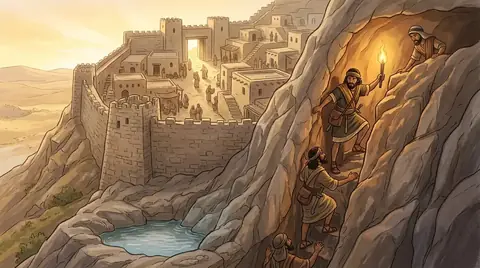 PlaceJerusalemThe city David made his capital and where Solomon built the temple. Jesus died and rose there and the church began…
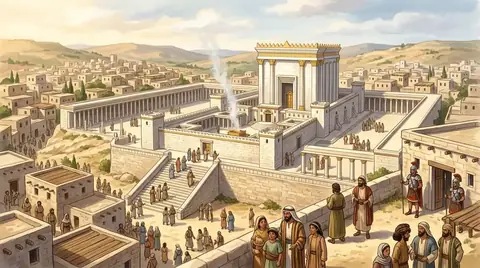 Thing · WorshipThe TempleGod's house in Jerusalem, where he was worshipped and the sacrifices offered. Solomon built it, Babylon burned it, the…
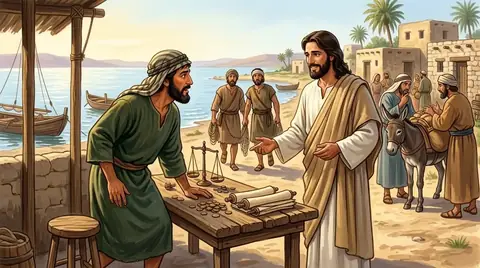 PersonMatthewA tax collector at Capernaum who left his booth the moment Jesus said "Follow me", became one of the twelve apostles…
Written for this app in its own words, from the Bible, with the facts checked against Bible dictionaries and encyclopedias: Easton's, Smith's, Fausset's, ISBE, Holman, the New Bible Dictionary, Vine's and the Thompson Chain topics. Also: Josephus, Antiquities.
