
Animal
Unclean birds (ossifrage, bittern)
The birds Israel was not to eat: eagles, vultures, owls, ravens and the rest
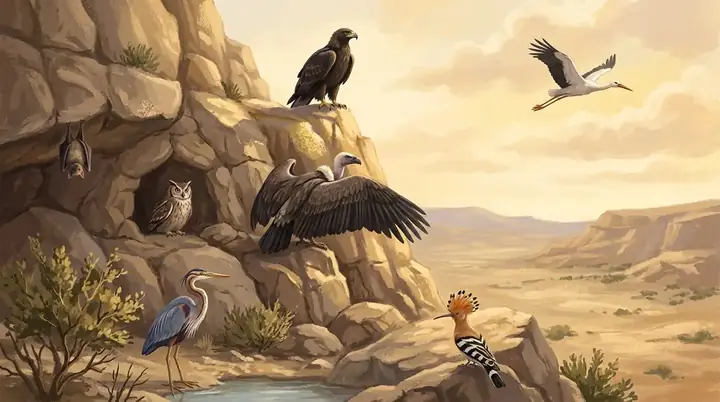
The birds the Law forbade Israel to eat: mostly hunters and scavengers that feed on flesh and blood. Several of the Hebrew bird names are hard to identify, and in the prophets they haunt the ruins of judged cities.
- Where
- Leviticus 11:13–19; Deuteronomy 14:12–18
- The list
- Eagle, ossifrage, osprey, vulture, kite, raven, owls, night hawk, cuckoo, hawk, cormorant, swan, pelican, gier eagle, stork, heron, lapwing, bat
- Ossifrage
- "Bone-breaker": the bearded vulture, which drops bones from a height to crack them
- Bittern
- A marsh bird with a booming call; the Hebrew may mean a hedgehog or an owl
Which birds
The Law gave no rule for telling a clean bird from an unclean one, as it did for animals and fish; it simply listed about twenty kinds that were not to be eaten (Leviticus 11:13–19; Deuteronomy 14:12–18). Nearly all of them are birds of prey or scavengers: eagles, vultures, kites, hawks and owls, the raven, the cormorant and the pelican. The ossifrage, "bone-breaker", is the bearded vulture or lammergeier, a huge bird that still carries bones high into the air and drops them on rocks to get at the marrow. The bat is on the list too, since it flies. Many of the Hebrew names are now hard to pin down, so English Bibles differ over them; the "swan" and "cuckoo" of the King James Version are probably an owl and a gull.
Why
The Law does not say why. The plainest reason is that these birds eat flesh with the blood in it, and dead and rotting things, and God had forbidden his people blood (Leviticus 17:10–14). To eat such a bird was to take in what it had taken in. The clean birds, the dove, the pigeon, the quail and the domestic fowl, feed on grain and seed. Whatever the reason, the point was that Israel was to be a people set apart even at the table (Leviticus 20:25–26).
In the prophets
The prophets picture God's judgment on a city by the birds that will roost in its ruins. Edom will be the home of the cormorant, the bittern, the owl and the raven (Isaiah 34:11–15); Babylon a "possession for the bittern" and pools of water (Isaiah 14:23); proud Nineveh a place where the cormorant and bittern lodge on the capitals of its fallen pillars (Zephaniah 2:14). The psalmist in his misery feels like "a pelican of the wilderness" and "an owl of the desert" (Psalms 102:6). Jesus took the distinction away for his followers (Mark 7:19; Acts 10:13–15).
Key verses
- Leviticus 11:13–19
And these are they which ye shall have in abomination among the fowls; they shall not be eaten, they are an abomination: the eagle, and the ossifrage, and the ospray, And the vulture, and the kite after his kind; Every raven after his kind; …
- Deuteronomy 14:12
But these are they of which ye shall not eat: the eagle, and the ossifrage, and the ospray,
- Isaiah 34:11
But the cormorant and the bittern shall possess it; the owl also and the raven shall dwell in it: and he shall stretch out upon it the line of confusion, and the stones of emptiness.
- Zephaniah 2:14
And flocks shall lie down in the midst of her, all the beasts of the nations: both the cormorant and the bittern shall lodge in the upper lintels of it; their voice shall sing in the windows; desolation shall be in the thresholds: for he shall uncover the cedar work.
- Psalms 102:6
I am like a pelican of the wilderness: I am like an owl of the desert.
Written for this app in its own words, from the Bible, with the facts checked against Bible dictionaries and encyclopedias: Easton's, Smith's, Fausset's, ISBE, Holman, the New Bible Dictionary, Vine's and the Thompson Chain topics.
