
Teaching
Uncharitableness
Also called unjust criticism, judging
Judging others harshly and thinking the worst of them. Jesus said, "Judge not, that ye be not judged," and told critics to take the beam out of their own eye before the speck in a brother's.
- Jesus
- Matthew 7:1–5; Luke 6:37–42; John 8:7
- Examples
- Eli towards Hannah (1 Samuel 1:14); Eliab towards David (1 Samuel 17:28); Job's friends (Job 42:7)
The problem
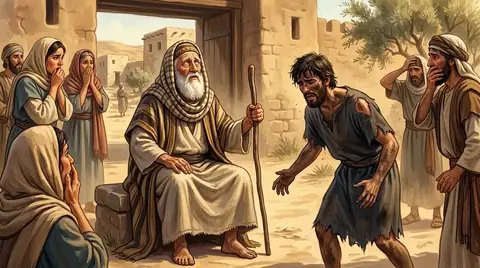
It is easy to judge others by the worst explanation. Eli took praying Hannah for a drunk woman (1 Samuel 1:13–14). Eliab accused young David of pride and a naughty heart when he came to the battle (1 Samuel 17:28). The princes of Ammon took David's kindness as spying (2 Samuel 10:3). Job's three friends insisted his sufferings proved hidden sin, and God was angry with them for not speaking what was right (Job 42:7–8). Nathanael asked, "Can there any good thing come out of Nazareth?" (John 1:46).
In Jesus
"Judge not, that ye be not judged" (Matthew 7:1). Jesus did not forbid telling right from wrong, but the hypocrite who sees the speck in a brother's eye and ignores the beam in his own (Matthew 7:3–5). To the men ready to stone a woman he said, "He that is without sin among you, let him first cast a stone" (John 8:7). "Judge not according to the appearance, but judge righteous judgment" (John 7:24).
For us
Paul says not to judge before the time, for the Lord will bring hidden things to light (1 Corinthians 4:5). Love "thinketh no evil" and "believeth all things" (1 Corinthians 13:5–7). See Charitableness.
Key verses
- Matthew 7:1–5
Judge not, that ye be not judged. For with what judgment ye judge, ye shall be judged: and with what measure ye mete, it shall be measured to you again. And why beholdest thou the mote that is in thy brother’s eye, but considerest not the beam that is in thine own eye? …
- John 7:24
Judge not according to the appearance, but judge righteous judgment.
- Romans 14:13
Let us not therefore judge one another any more: but judge this rather, that no man put a stumblingblock or an occasion to fall in his brother’s way.
- 1 Corinthians 13:4–7
Charity suffereth long, and is kind; charity envieth not; charity vaunteth not itself, is not puffed up, Doth not behave itself unseemly, seeketh not her own, is not easily provoked, thinketh no evil; Rejoiceth not in iniquity, but rejoiceth in the truth; …
- James 4:11–12
Speak not evil one of another, brethren. He that speaketh evil of his brother, and judgeth his brother, speaketh evil of the law, and judgeth the law: but if thou judge the law, thou art not a doer of the law, but a judge. There is one lawgiver, who is able to save and to destroy: who art thou that judgest another?
Read next
 PersonEliThe old high priest at Shiloh who raised the boy Samuel. A kind man, he failed to restrain his wicked sons, and died…
 PersonHannahThe childless wife of Elkanah who prayed for a son at Shiloh, promised him to God, and became the mother of the prophet…
 PersonEliabDavid's eldest brother, tall and impressive, whom Samuel nearly anointed king, and who scolded David at the battle line…Person · KingDavidThe shepherd boy who killed Goliath and became Israel's greatest king, "a man after God's own heart". He wrote many…
 PersonNathanaelA disciple from Cana whom Philip brought to Jesus. He doubted that anything good could come from Nazareth, but when…TeachingCharitablenessThinking and acting kindly towards others: slow to blame, quick to forgive, ready to cover a fault rather than spread…
Written for this app in its own words, from the Bible, with the facts checked against Bible dictionaries and encyclopedias: Easton's, Smith's, Fausset's, ISBE, Holman, the New Bible Dictionary, Vine's and the Thompson Chain topics.
