
Thing
Tools
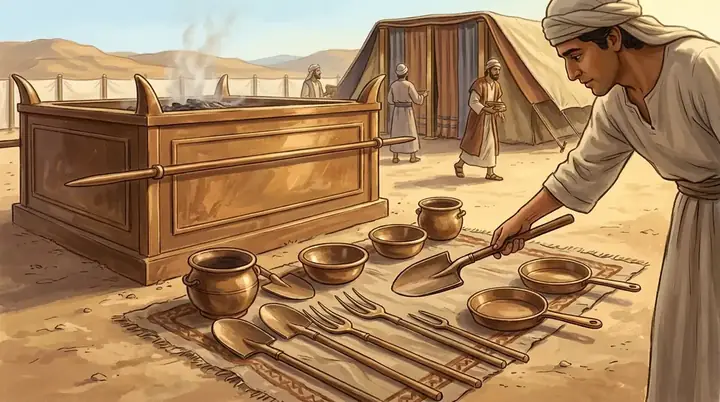
The tools of Bible times were simple: axes, saws, hammers, ploughs, sickles and chisels of bronze and later iron. God forbade tools on his altar stones, and the temple stones were shaped before they arrived.
- First metalworker
- Tubal-cain (Genesis 4:22)
- Altar
- No tool to be lifted on its stones (Exodus 20:25)
- Temple
- No hammer, axe or tool heard while building (1 Kings 6:7)
What they were
From early times men worked with tools of stone, bronze and iron. Tubal-cain was the first to forge them (Genesis 4:22). The Bible mentions axes and saws, hammers and nails, ploughshares, mattocks, sickles, goads, files and the carpenter's line and compass (Isaiah 44:12–13). In Saul's day the Philistines kept all the smiths, so Israel had to go to them even to sharpen a hoe (1 Samuel 13:19–21).
In worship
An altar of stone was to be built of uncut stones, for "if thou lift up thy tool upon it, thou hast polluted it" (Exodus 20:25; Deuteronomy 27:5). The work was to be God's, not man's. In the same spirit the stones of Solomon's temple were prepared at the quarry, so that "there was neither hammer nor axe nor any tool of iron heard in the house" (1 Kings 6:7).
For us
Jesus himself worked with tools as a carpenter (Mark 6:3). Honest work with the hands is honoured in Scripture (Ephesians 4:28).
Key verses
- Genesis 4:22
And Zillah, she also bare Tubal–cain, an instructer of every artificer in brass and iron: and the sister of Tubal–cain was Naamah.
- Exodus 20:25
And if thou wilt make me an altar of stone, thou shalt not build it of hewn stone: for if thou lift up thy tool upon it, thou hast polluted it.
- 1 Samuel 13:19–21
Now there was no smith found throughout all the land of Israel: for the Philistines said, Lest the Hebrews make them swords or spears: But all the Israelites went down to the Philistines, to sharpen every man his share, and his coulter, and his axe, and his mattock. Yet they had a file for the mattocks, and for the coulters, and for the forks, and for the axes, and to sharpen the goads.
- 1 Kings 6:7
And the house, when it was in building, was built of stone made ready before it was brought thither: so that there was neither hammer nor axe nor any tool of iron heard in the house, while it was in building.
- Mark 6:3
Is not this the carpenter, the son of Mary, the brother of James, and Joses, and of Juda, and Simon? and are not his sisters here with us? And they were offended at him.
Read next
Written for this app in its own words, from the Bible, with the facts checked against Bible dictionaries and encyclopedias: Easton's, Smith's, Fausset's, ISBE, Holman, the New Bible Dictionary, Vine's and the Thompson Chain topics.
