
Teaching
Superstition
Fearful or magical belief about unseen powers, in place of trust in the living God. Israel treated the ark like a lucky charm, the Philistines avoided Dagon's threshold, and the disciples thought Jesus on the water was a ghost.
- Instances
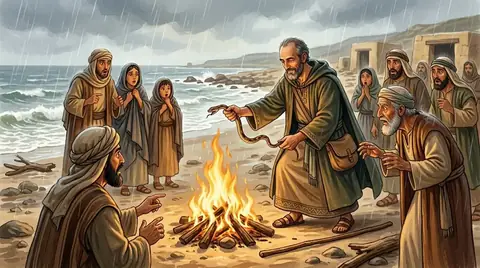
- The ark taken to battle (1 Samuel 4:3–11); Dagon's threshold (1 Samuel 5:5); cakes for the queen of heaven (Jeremiah 44:19); the sailors with Jonah (Jonah 1:4–16); "It is a spirit" (Matthew 14:26); Malta (Acts 28:6)
- Festus
- Paul's accusers had "questions... of their own superstition" (Acts 25:19)
In the Old Testament
After a defeat, Israel's elders sent for the ark, sure that it would save them; it was captured and thirty thousand died (1 Samuel 4:3–11). God is not a charm to be carried about. The Philistines, after Dagon's statue fell before the ark, would never step on the threshold of his temple (1 Samuel 5:5). The Syrians decided Israel's God was a god of hills only (1 Kings 20:23). The people who fled to Egypt blamed their disasters on giving up their incense for the queen of heaven (Jeremiah 44:18).
In the New Testament
When Jesus walked on the sea, the disciples cried out in fear, "It is a spirit" (Matthew 14:26). Herod thought Jesus was John the Baptist risen (Mark 6:14–16). The believers praying for Peter thought it must be his angel at the door (Acts 12:15). In Malta the islanders first decided Paul was a murderer when a snake bit him, then that he was a god when he did not die (Acts 28:4–6). Paul told the Athenians they were "too superstitious", and proclaimed to them the unknown God (Acts 17:22–23).
For us
God calls us out of fear into trust. "God hath not given us the spirit of fear; but of power, and of love, and of a sound mind" (2 Timothy 1:7).
Key verses
- 1 Samuel 4:3
And when the people were come into the camp, the elders of Israel said, Wherefore hath the Lord smitten us to day before the Philistines? Let us fetch the ark of the covenant of the Lord out of Shiloh unto us, that, when it cometh among us, it may save us out of the hand of our enemies.
- Jeremiah 44:17–18
But we will certainly do whatsoever thing goeth forth out of our own mouth, to burn incense unto the queen of heaven, and to pour out drink offerings unto her, as we have done, we, and our fathers, our kings, and our princes, in the cities of Judah, and in the streets of Jerusalem: for then had we plenty of victuals, and were well, and saw no evil. But since we left off to burn incense to the queen of heaven, and to pour out drink offerings unto her, we have wanted all things, and have been consumed by the sword and by the famine.
- Matthew 14:26–27
And when the disciples saw him walking on the sea, they were troubled, saying, It is a spirit; and they cried out for fear. But straightway Jesus spake unto them, saying, Be of good cheer; it is I; be not afraid.
- Acts 17:22–23
Then Paul stood in the midst of Mars’ hill, and said, Ye men of Athens, I perceive that in all things ye are too superstitious. For as I passed by, and beheld your devotions, I found an altar with this inscription, TO THE UNKNOWN GOD. Whom therefore ye ignorantly worship, him declare I unto you.
- 2 Timothy 1:7
For God hath not given us the spirit of fear; but of power, and of love, and of a sound mind.
Read next
Written for this app in its own words, from the Bible, with the facts checked against Bible dictionaries and encyclopedias: Easton's, Smith's, Fausset's, ISBE, Holman, the New Bible Dictionary, Vine's and the Thompson Chain topics.
