
Teaching
Succession
Of priests and kings
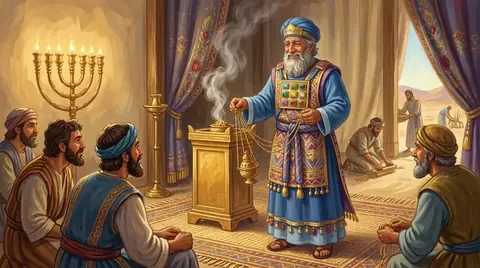
The passing on of an office. Israel's priesthood passed from father to son in Aaron's line, and the kingship in David's. Hebrews shows Jesus as a priest of another order, Melchizedek's, who never needs a successor.
- Priests
- From Aaron to his sons (Numbers 20:25–28)
- Kings
- David's line promised for ever (2 Samuel 7:12–16)
- Christ
- A priest "for ever after the order of Melchisedec" (Hebrews 7:17)
Priests and kings
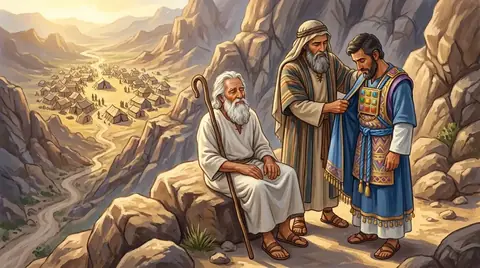
When Aaron was about to die on Mount Hor, Moses took his garments and put them on his son Eleazar (Numbers 20:25–28), and the high priesthood passed down his family. Kings were usually followed by a son. God promised David that one of his own sons would sit on his throne, and that his house and kingdom would be established for ever (2 Samuel 7:12–16). In the northern kingdom, by contrast, there was no settled line, and dynasty after dynasty was overthrown.
In Jesus
Hebrews points out that the priests of Aaron's line "were not suffered to continue by reason of death" (Hebrews 7:23), so there was always a new one. Jesus came from the tribe of Judah, not Levi; he is a priest by God's oath "after the order of Melchisedec," like the king-priest of Genesis who has no recorded beginning or end (Hebrews 7:1–17). Because he lives for ever, his priesthood never passes to anyone else, and "he is able also to save them to the uttermost that come unto God by him" (Hebrews 7:24–25). He is also David's heir, whose kingdom will have no end (Luke 1:32–33).
Key verses
- Numbers 20:25–28
Take Aaron and Eleazar his son, and bring them up unto mount Hor: And strip Aaron of his garments, and put them upon Eleazar his son: and Aaron shall be gathered unto his people, and shall die there. And Moses did as the Lord commanded: and they went up into mount Hor in the sight of all the congregation. …
- 2 Samuel 7:12–16
And when thy days be fulfilled, and thou shalt sleep with thy fathers, I will set up thy seed after thee, which shall proceed out of thy bowels, and I will establish his kingdom. He shall build an house for my name, and I will stablish the throne of his kingdom for ever. I will be his father, and he shall be my son. If he commit iniquity, I will chasten him with the rod of men, and with the stripes of the children of men: …
- Hebrews 7:23–25
And they truly were many priests, because they were not suffered to continue by reason of death: But this man, because he continueth ever, hath an unchangeable priesthood. Wherefore he is able also to save them to the uttermost that come unto God by him, seeing he ever liveth to make intercession for them.
- Luke 1:32–33
He shall be great, and shall be called the Son of the Highest: and the Lord God shall give unto him the throne of his father David: And he shall reign over the house of Jacob for ever; and of his kingdom there shall be no end.
Read next
Written for this app in its own words, from the Bible, with the facts checked against Bible dictionaries and encyclopedias: Easton's, Smith's, Fausset's, ISBE, Holman, the New Bible Dictionary, Vine's and the Thompson Chain topics.
