
Thing
Staves
Long poles or clubs
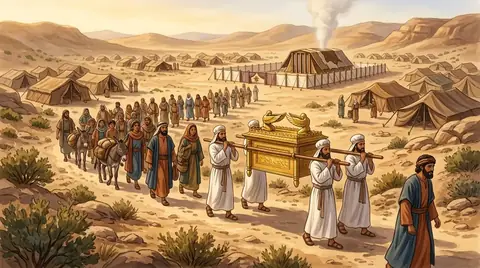
Staves were long poles: for carrying the ark and the holy furniture of the tabernacle, as walking sticks and as clubs. The crowd that came to arrest Jesus carried swords and staves; Zechariah broke two staves called Beauty and Bands.
- Tabernacle
- Poles of acacia overlaid with gold to carry the ark, table and altars (Exodus 25:13–15)
- Arrest of Jesus
- "A great multitude with swords and staves" (Matthew 26:47)
- Zechariah
- Two staves, Beauty and Bands (Zechariah 11:7–14)
Carrying holy things
The ark of the covenant, the table and the altars all had rings at their sides, and staves of acacia wood overlaid with gold went through them so the Levites could carry them on their shoulders (Exodus 25:13–15; Exodus 25:27–28). The staves of the ark were never to be taken out (Exodus 25:15). When David tried to move the ark on a cart instead, it ended in Uzzah's death (1 Chronicles 15:13–15).
As weapons
At Gethsemane Judas came with "a great multitude with swords and staves" from the chief priests (Matthew 26:47; Mark 14:43). Jesus asked whether they had come out against him as against a thief (Matthew 26:55).
A sign
Zechariah, acting as a shepherd, took two staves, Beauty and Bands, and broke them, to show God's covenant broken and the union of Judah and Israel undone; in the same passage he was paid off with thirty pieces of silver and threw them to the potter (Zechariah 11:7–14). Matthew sees that fulfilled in Judas' price (Matthew 27:9–10).
Key verses
- Exodus 25:13–15
And thou shalt make staves of shittim wood, and overlay them with gold. And thou shalt put the staves into the rings by the sides of the ark, that the ark may be borne with them. The staves shall be in the rings of the ark: they shall not be taken from it.
- 1 Chronicles 15:15
And the children of the Levites bare the ark of God upon their shoulders with the staves thereon, as Moses commanded according to the word of the Lord.
- Matthew 26:47
And while he yet spake, lo, Judas, one of the twelve, came, and with him a great multitude with swords and staves, from the chief priests and elders of the people.
- Zechariah 11:7–14
And I will feed the flock of slaughter, even you, O poor of the flock. And I took unto me two staves; the one I called Beauty, and the other I called Bands; and I fed the flock. Three shepherds also I cut off in one month; and my soul lothed them, and their soul also abhorred me. Then said I, I will not feed you: that that dieth, let it die; and that that is to be cut off, let it be cut off; and let the rest eat every one the flesh of another. …
Read next
Written for this app in its own words, from the Bible, with the facts checked against Bible dictionaries and encyclopedias: Easton's, Smith's, Fausset's, ISBE, Holman, the New Bible Dictionary, Vine's and the Thompson Chain topics.
