
Place · Nature
Spring
Hebrew ayin, "an eye" · also the season of the year
A place where water comes up out of the ground on its own: the most precious thing in a dry land, and a favourite picture of God's life-giving goodness. The word also names the season after winter.
- Hebrew
- Ayin, "eye", the bright spot where water shows in the land
- Not the same as
- A well, which is dug, and a cistern, which stores rain
- Famous springs
- Elim's twelve (Exodus 15:27); Gihon at Jerusalem (2 Chronicles 32:30); En-gedi
Water from the ground
In Israel rain falls only in winter, so for half the year the land lives on the water stored in the hills, which comes out in springs. The Hebrew word for a spring means an eye, as though the water were the bright eye of the landscape. Many place names begin with it: En-gedi, "spring of the kid", En-rogel, Endor. A spring is different from a well, which men dig to reach water, and from a cistern, which only holds rain.
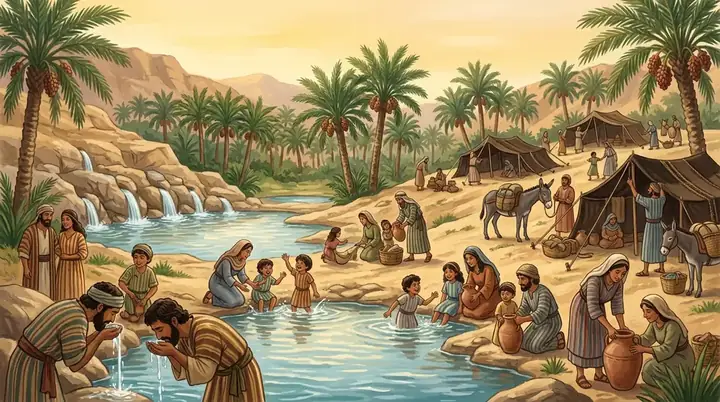
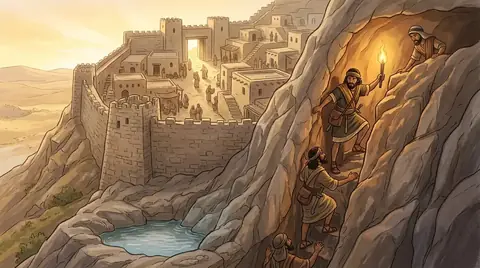
The best stretch of Israel's wilderness road was Elim, with its twelve springs and seventy palm trees (Exodus 15:27). Achsah, Caleb's daughter, asked her father for springs to go with her dry land, and he gave her the upper and the lower (Joshua 15:19). Hezekiah's workmen cut a tunnel to bring the Gihon spring inside the walls of Jerusalem before the Assyrians came (2 Chronicles 32:30), and stopped the springs outside so that the enemy would find no water (2 Chronicles 32:3–4).
The season
God promised Noah that seedtime and harvest, cold and heat, would never cease while the earth lasted (Genesis 8:22). The Song of Songs has the Bible's loveliest spring: the winter is past, the rain is over, flowers appear and the turtledove is heard (Song of Songs 2:11–13).
What it means
A spring is a picture of what comes from inside. A good man who gives way before the wicked is "a troubled fountain, and a corrupt spring" (Proverbs 25:26); a spring cannot give both sweet water and bitter, says James, so neither should a mouth (James 3:11). God himself is "the fountain of living waters" that Israel forsook (Jeremiah 2:13), and Jesus promised that whoever drinks from him will have "a well of water springing up into everlasting life" (John 4:14).
Key verses
- Exodus 15:27
And they came to Elim, where were twelve wells of water, and threescore and ten palm trees: and they encamped there by the waters.
- Proverbs 25:26
A righteous man falling down before the wicked is as a troubled fountain, and a corrupt spring.
- James 3:11
Doth a fountain send forth at the same place sweet water and bitter?
- John 4:14
But whosoever drinketh of the water that I shall give him shall never thirst; but the water that I shall give him shall be in him a well of water springing up into everlasting life.
Read next
Written for this app in its own words, from the Bible, with the facts checked against Bible dictionaries and encyclopedias: Easton's, Smith's, Fausset's, ISBE, Holman, the New Bible Dictionary, Vine's and the Thompson Chain topics.
