
Person · Enemy
Sisera
SIS-er-aOld Testament · the period of the judges, about 1200 BC
The Canaanite general with nine hundred iron chariots who crushed Israel for twenty years. Deborah and Barak routed his army, and he died in a tent with a peg through his head, killed by Jael.
- Where
- Commander for Jabin king of Hazor; lived at Harosheth of the Gentiles (Judges 4:2)
- Known for
- Nine hundred iron chariots; beaten at the river Kishon; killed by Jael
- Where
- Judges 4–5; 1 Samuel 12:9; Psalms 83:9
His story
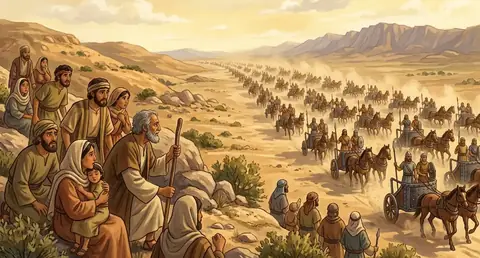
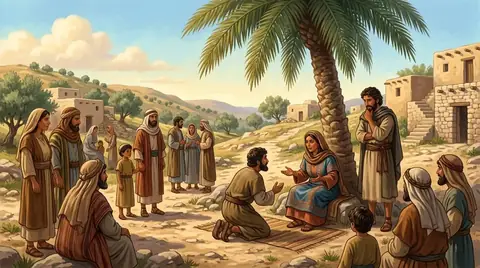
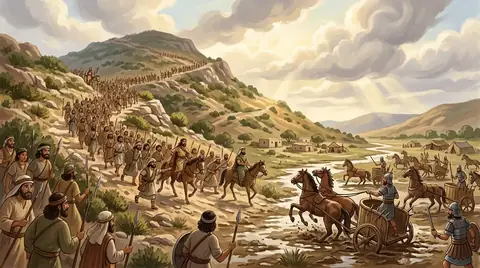
For twenty years Sisera's chariots made life a misery in northern Israel; the roads were empty and villages deserted (Judges 4:3; Judges 5:6–7). Deborah, the prophetess who judged Israel under her palm tree, sent for Barak and told him God's orders: take ten thousand men to Mount Tabor, and God would draw Sisera to the river Kishon and give him into Barak's hand. Barak would only go if Deborah came too, so she warned him that the honour of the kill would go to a woman (Judges 4:6–9).
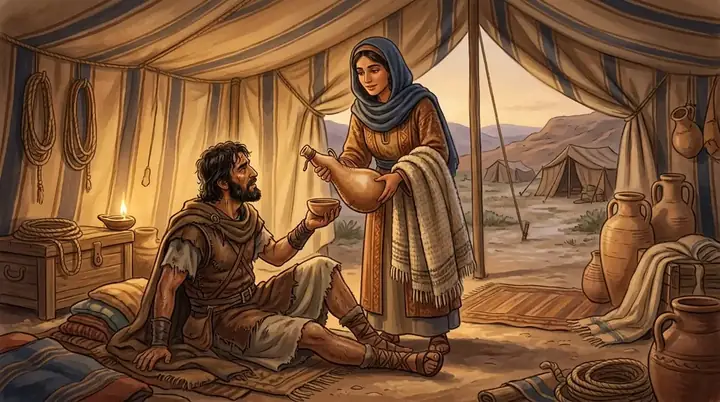
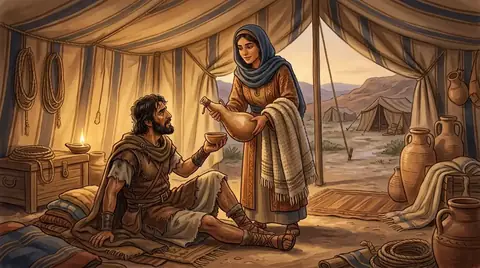
Sisera brought his whole force to the Kishon. God sent a storm; the river flooded, the plain turned to mud, and the chariots were useless (Judges 5:20–21). Israel swept down the mountain and Sisera's army was wiped out. Sisera himself jumped from his chariot and ran. He reached the tent of Heber the Kenite, whose family was at peace with Jabin, and Heber's wife Jael invited him in, covered him with a rug, gave him milk when he asked for water, and promised to keep watch. When he was fast asleep she took a tent peg and a hammer and drove the peg through his temple into the ground (Judges 4:17–21). Barak arrived in pursuit to find his enemy dead.
Deborah's song ends with Sisera's mother at her window, wondering why his chariot is so late and comforting herself that he must be dividing the spoil (Judges 5:28–30).
What to learn
Iron chariots were the tanks of their day, and Israel had none. God used rain, a woman judge, a reluctant general and a housewife with a tent peg. Later generations remembered Sisera as proof that God can bring down any oppressor (1 Samuel 12:9; Psalms 83:9). A family of temple servants that came back from Babylon were also called "the children of Sisera" (Ezra 2:53).
Key verses
- Judges 4:2–3
And the Lord sold them into the hand of Jabin king of Canaan, that reigned in Hazor; the captain of whose host was Sisera, which dwelt in Harosheth of the Gentiles. And the children of Israel cried unto the Lord: for he had nine hundred chariots of iron; and twenty years he mightily oppressed the children of Israel.
- Judges 4:14–16
And Deborah said unto Barak, Up; for this is the day in which the Lord hath delivered Sisera into thine hand: is not the Lord gone out before thee? So Barak went down from mount Tabor, and ten thousand men after him. And the Lord discomfited Sisera, and all his chariots, and all his host, with the edge of the sword before Barak; so that Sisera lighted down off his chariot, and fled away on his feet. But Barak pursued after the chariots, and after the host, unto Harosheth of the Gentiles: and all the host of Sisera fell upon the edge of the sword; and there was not a man left.
- Judges 4:21
Then Jael Heber’s wife took a nail of the tent, and took an hammer in her hand, and went softly unto him, and smote the nail into his temples, and fastened it into the ground: for he was fast asleep and weary. So he died.
- Judges 5:20–21
They fought from heaven; the stars in their courses fought against Sisera. The river of Kishon swept them away, that ancient river, the river Kishon. O my soul, thou hast trodden down strength.
- Psalms 83:9
Do unto them as unto the Midianites; as to Sisera, as to Jabin, at the brook of Kison:
Mentioned in 17 verses
- Judges 15
- 1 Samuel 1
- Psalms 1
Read next
 PersonJabinThe name of two kings of Hazor in the north of Canaan: one defeated by Joshua, and a later one who oppressed Israel for…PlaceHazorThe greatest city of Canaan in Joshua's day, head of the northern kings, burnt by Joshua and later the base of Jabin…
 PersonJaelThe wife of Heber the Kenite, who killed Sisera, the Canaanite general, with a tent peg while he slept in her tent…
 PersonDeborahA prophetess who judged Israel from under a palm tree in Ephraim. She summoned Barak to fight Sisera, went with him to…
 PersonBarakThe commander from Naphtali who, with the prophetess Deborah beside him, led ten thousand men down Mount Tabor and…
 PlaceTaborThe name of a well-known mountain in Galilee, of an oak near Bethel where Saul was given a sign, and of a Levite town…Place · RiverKishonThe stream that drains the valley of Jezreel to the Mediterranean below Mount Carmel. It swept away Sisera's chariots…
Written for this app in its own words, from the Bible, with the facts checked against Bible dictionaries and encyclopedias: Easton's, Smith's, Fausset's, ISBE, Holman, the New Bible Dictionary, Vine's and the Thompson Chain topics. People and places: STEPBible.org (TIPNR), CC BY 4.0; where a place is today and its photo: OpenBible.info, CC BY 4.0.
