
Tool · Farming
Sickle
A short curved blade for cutting grain at harvest. In the prophets and in Revelation the sickle is a picture of God's judgement, when the harvest of the earth is ripe and is reaped.
- Used for
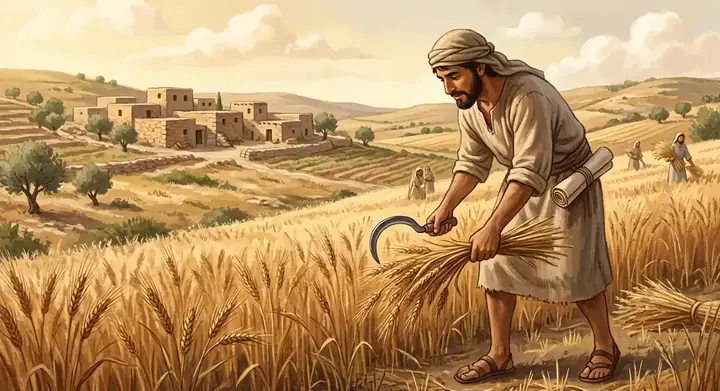
- Cutting standing grain, by the handful, near the top of the stalk
- Where
- Deuteronomy 16:9; Deuteronomy 23:25; Jeremiah 50:16; Joel 3:13; Mark 4:29; Revelation 14:14–19
What it was
The reaper took hold of a bunch of stalks and cut them with a sickle, a curved blade set in a wooden handle. The earliest were flint teeth fixed in bone or wood; later they were iron. The feast of weeks was counted from the day the sickle was first put to the standing grain (Deuteronomy 16:9). A hungry traveller could pluck ears of grain by hand in a neighbour's field, but not cut them with a sickle (Deuteronomy 23:25).
What it means
Jesus says the kingdom grows quietly like seed, and when the grain is ripe the farmer "putteth in the sickle" (Mark 4:29). Joel turns the picture to judgement: "Put ye in the sickle, for the harvest is ripe" (Joel 3:13). In Revelation one like the Son of man sits on a cloud with a sharp sickle and reaps the earth, and an angel gathers the grapes of the earth into the winepress of God's wrath (Revelation 14:14–19). The sickle means that God's patience has a harvest time; sin ripens, and so does the gathering in of his people.
Key verses
- Deuteronomy 16:9
Seven weeks shalt thou number unto thee: begin to number the seven weeks from such time as thou beginnest to put the sickle to the corn.
- Joel 3:13
Put ye in the sickle, for the harvest is ripe: come, get you down; for the press is full, the fats overflow; for their wickedness is great.
- Mark 4:29
But when the fruit is brought forth, immediately he putteth in the sickle, because the harvest is come.
- Revelation 14:15
And another angel came out of the temple, crying with a loud voice to him that sat on the cloud, Thrust in thy sickle, and reap: for the time is come for thee to reap; for the harvest of the earth is ripe.
Read next
Written for this app in its own words, from the Bible, with the facts checked against Bible dictionaries and encyclopedias: Easton's, Smith's, Fausset's, ISBE, Holman, the New Bible Dictionary, Vine's and the Thompson Chain topics.
