
Teaching · Law
Restitution
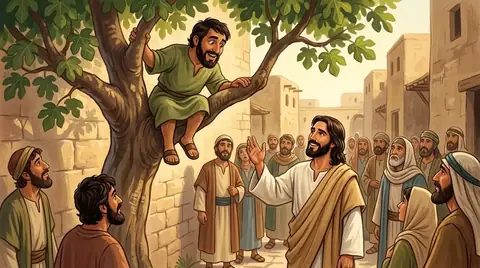
Making good the harm you have done: paying back what was stolen, damaged or gained by cheating, usually with something added. Zacchaeus, after meeting Jesus, promised to repay fourfold.
- Theft
- Up to five oxen for one (Exodus 22:1)
- Fraud
- Full repayment plus a fifth (Leviticus 6:4–5; Numbers 5:7)
- Example
- Zacchaeus (Luke 19:8)
The law
God's law did not stop at punishment; it put things right for the one wronged. A thief who killed or sold a stolen ox had to repay five oxen, and four sheep for a sheep (Exodus 22:1). If the animal was found alive in his hands, he repaid double (Exodus 22:4). Whoever cheated a neighbour, kept what was lost, or lied about a deposit had to restore it in full and add a fifth, and then bring a guilt offering to God (Leviticus 6:2–7; Numbers 5:6–7). Damage to a neighbour's animals or fields was paid for too (Exodus 21:33–36; Exodus 22:5–6).
In the prophets
Ezekiel names giving back the pledge and returning what was robbed as signs that a wicked man has truly turned (Ezekiel 33:15).
In Jesus
When Jesus invited himself to Zacchaeus's house, the chief tax collector stood up and said, "the half of my goods I give to the poor; and if I have taken any thing from any man by false accusation, I restore him fourfold". Jesus answered, "This day is salvation come to this house" (Luke 19:8–9). True repentance does not only say sorry; where it can, it puts right.
Key verses
- Exodus 22:1
If a man shall steal an ox, or a sheep, and kill it, or sell it; he shall restore five oxen for an ox, and four sheep for a sheep.
- Leviticus 6:4–5
Then it shall be, because he hath sinned, and is guilty, that he shall restore that which he took violently away, or the thing which he hath deceitfully gotten, or that which was delivered him to keep, or the lost thing which he found, Or all that about which he hath sworn falsely; he shall even restore it in the principal, and shall add the fifth part more thereto, and give it unto him to whom it appertaineth, in the day of his trespass offering.
- Ezekiel 33:15
If the wicked restore the pledge, give again that he had robbed, walk in the statutes of life, without committing iniquity; he shall surely live, he shall not die.
- Luke 19:8–9
And Zaccheus stood, and said unto the Lord; Behold, Lord, the half of my goods I give to the poor; and if I have taken any thing from any man by false accusation, I restore him fourfold. And Jesus said unto him, This day is salvation come to this house, forsomuch as he also is a son of Abraham.
Read next
Written for this app in its own words, from the Bible, with the facts checked against Bible dictionaries and encyclopedias: Easton's, Smith's, Fausset's, ISBE, Holman, the New Bible Dictionary, Vine's and the Thompson Chain topics.
