
Name of God · Title of Christ
The Redeemer
In Israel a redeemer was the near relative whose job it was to buy back a family member from slavery or his land from loss. God took that name for himself, and Christ, by becoming our kinsman, bought his people back.
- Hebrew
- goel, the kinsman with the right to redeem
- Where
- Leviticus 25:25, 47–49; Ruth 4; Job 19:25; Isaiah 59:20; Galatians 3:13
- Also called
- The Holy One of Israel, your Redeemer (Isaiah 41:14)
In the Old Testament
The law of Moses gave every Israelite family a safety net: the goel, the nearest relative. If a man fell into debt and sold his land, his kinsman could buy it back (Leviticus 25:25). If he sold himself into slavery, a relative could pay his price and free him (Leviticus 25:47–49). The kinsman also avenged a murdered relative's blood (Numbers 35:19). Boaz did the work of a redeemer for Ruth and Naomi, buying back the family land and marrying the widow so the name would live on (Ruth 4:1–10).
God called himself Israel's Redeemer, the kinsman who would not leave his people in bondage. He redeemed them from Egypt (Exodus 6:6), and Isaiah uses the title again and again for the God who would bring them home from Babylon: "thy Redeemer, the Holy One of Israel" (Isaiah 41:14; Isaiah 54:5). Job, sick and accused, cried, "I know that my redeemer liveth," and expected to see him with his own eyes (Job 19:25–27). David closed a psalm by calling the LORD "my strength, and my redeemer" (Psalms 19:14).
In Jesus
A redeemer had to be a relative, had to be able to pay, and had to be willing. Jesus met all three. He became our kinsman by taking flesh and blood (Hebrews 2:14), paid with his own life, and did it gladly. Paul says "Christ hath redeemed us from the curse of the law, being made a curse for us" (Galatians 3:13), and Isaiah's promise that "the Redeemer shall come to Zion" (Isaiah 59:20) is applied to him (Romans 11:26). In heaven the song is to the Lamb who "hast redeemed us to God by thy blood" (Revelation 5:9).
For us
To call Christ Redeemer is to confess that we were not free, that we could not pay, and that he bought us. See Redemption and Ransom.
Key verses
- Job 19:25
For I know that my redeemer liveth, and that he shall stand at the latter day upon the earth:
- Isaiah 59:20
And the Redeemer shall come to Zion, and unto them that turn from transgression in Jacob, saith the Lord.
- Galatians 3:13
Christ hath redeemed us from the curse of the law, being made a curse for us: for it is written, Cursed is every one that hangeth on a tree:
- Revelation 5:9
And they sung a new song, saying, Thou art worthy to take the book, and to open the seals thereof: for thou wast slain, and hast redeemed us to God by thy blood out of every kindred, and tongue, and people, and nation;
Read next
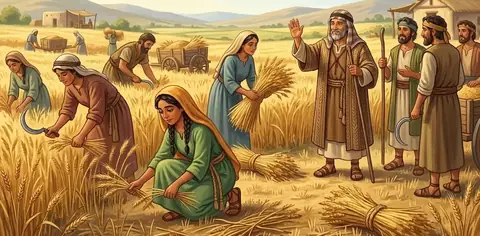 PersonBoazA wealthy farmer of Bethlehem who married Ruth, the Moabite widow, as her kinsman-redeemer. Their great-grandson was…
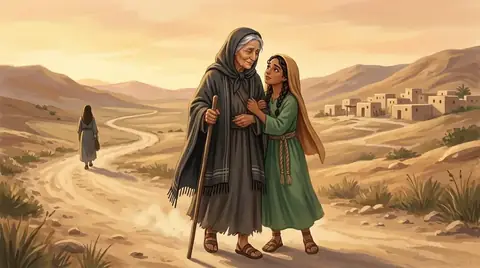 PersonRuthA young widow from Moab who left her own land to stay with her mother-in-law Naomi and trust Israel's God. She married…
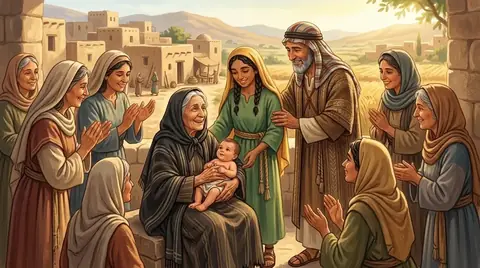 PersonNaomiA widow of Bethlehem who lost her husband and both sons in Moab, came home bitter and empty, and found through her…
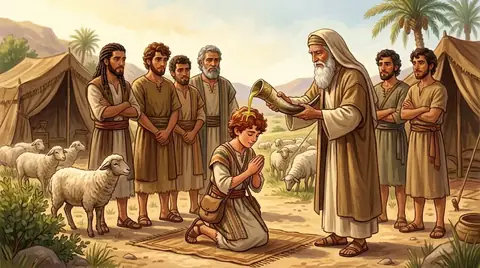 Person · KingDavidThe shepherd boy who killed Goliath and became Israel's greatest king, "a man after God's own heart". He wrote many…TeachingRedemptionBuying something back by paying a price. Christ's death is the price that frees his people from sin's slavery and…TeachingRansomA price paid to set someone free. Jesus said he came to give his life "a ransom for many": his death is the price that…
Written for this app in its own words, from the Bible, with the facts checked against Bible dictionaries and encyclopedias: Easton's, Smith's, Fausset's, ISBE, Holman, the New Bible Dictionary, Vine's and the Thompson Chain topics.
