
Saying
Not one stone upon another
Jesus' words about the temple in Jerusalem, meaning total destruction. Forty years later the Romans burned it and tore it down, and the fallen stones still lie at the foot of the mount.
- Where
- Matthew 24:2; Mark 13:2; Luke 19:44; Luke 21:6
- Fulfilled
- AD 70, when Titus's legions took Jerusalem
Where it comes from
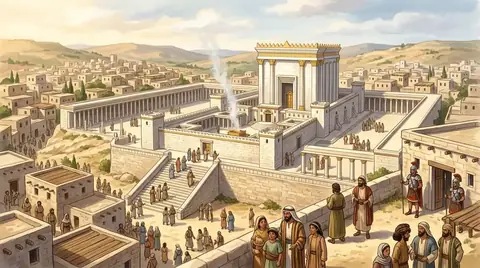
As Jesus left the temple for the last time, his disciples pointed out its buildings. Herod had been rebuilding it for fifty years with blocks of white stone, some of them 40 feet (12 m) long, and gold on the front that blazed in the sun. Jesus answered, "There shall not be left here one stone upon another, that shall not be thrown down" (Matthew 24:2). Earlier, riding into the city, he had wept over it and said its enemies would level it to the ground, and its children with it, "because thou knewest not the time of thy visitation" (Luke 19:41–44).
What happened
The disciples asked when, and Jesus' answer, the sermon on the Mount of Olives, fills the next chapters. In AD 66 the Jews rose against Rome. Four years later the Roman general Titus took Jerusalem after a terrible siege. The temple caught fire and was burned, and the soldiers pulled down what the fire left, prying the stones apart for the gold that had melted between them. Only the great retaining walls of the platform survived, one of them the Western Wall where Jews pray today. The toppled stones of the temple's edge still lie in a heap on the street below, where they have been dug out.
What it means
The saying has become a phrase for complete ruin. For the first Christians it was also a sign that Jesus' words come true, and that God's house is no longer a building but his people, with Christ as the cornerstone (Ephesians 2:20–22).
Key verses
- Matthew 24:2
And Jesus said unto them, See ye not all these things? verily I say unto you, There shall not be left here one stone upon another, that shall not be thrown down.
- Luke 19:44
And shall lay thee even with the ground, and thy children within thee; and they shall not leave in thee one stone upon another; because thou knewest not the time of thy visitation.
- Luke 21:6
As for these things which ye behold, the days will come, in the which there shall not be left one stone upon another, that shall not be thrown down.
Read next
Written for this app in its own words, from the Bible, with the facts checked against Bible dictionaries and encyclopedias: Easton's, Smith's, Fausset's, ISBE, Holman, the New Bible Dictionary, Vine's and the Thompson Chain topics. Also: Josephus, The Jewish War.
