
Thing
Moabite Stone
also called the Mesha Stele; found at Dibon in 1868
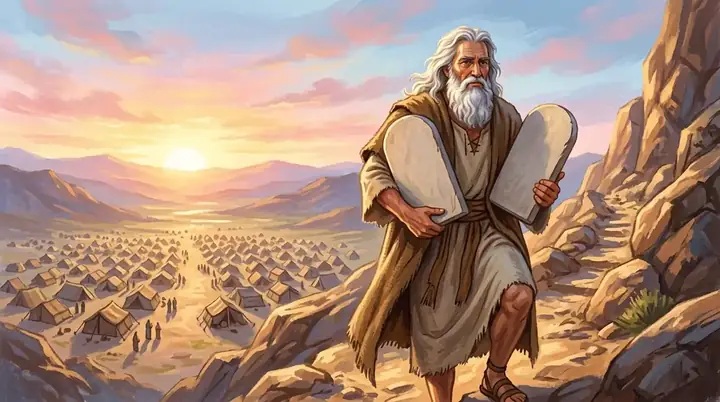
A black basalt slab set up by Mesha king of Moab about 850 BC to boast of his victories over Israel. Found at Dibon in 1868, it names Omri king of Israel, the god Chemosh and the LORD, and agrees with 2 Kings 3.
- Found
- At Dibon, east of the Dead Sea, in 1868
- Size
- About 3½ feet (1.1 m) high, 2 feet (60 cm) wide, 34 lines
- Set up by
- Mesha king of Moab (2 Kings 3:4)
What it is
The stone was found by a German missionary at Dibon in 1868, rounded at the top and covered with thirty-four lines of writing in an alphabet very like early Hebrew. Local people broke it up before it could be taken away, but a paper squeeze had already been made, and most of the pieces were recovered. It is now in the Louvre in Paris.
What it says
Mesha says that Omri king of Israel had oppressed Moab for many years, "because Chemosh was angry with his land", and that Mesha won his land back, took Israelite towns such as Nebo and Ataroth, and carried off vessels of the LORD to his god Chemosh. He tells of cities and roads he built. The Bible says the same in its own way: Mesha had paid Israel a huge tribute of lambs and wool, and rebelled after Ahab died (2 Kings 1:1; 2 Kings 3:4–5).
Why it matters
It is one of the oldest long inscriptions in the alphabet ever found, shows that Moab's language was close to Hebrew, and confirms the Bible's account of a real king, a real war and a real people.
Key verses
- 2 Kings 3:4–5
And Mesha king of Moab was a sheepmaster, and rendered unto the king of Israel an hundred thousand lambs, and an hundred thousand rams, with the wool. But it came to pass, when Ahab was dead, that the king of Moab rebelled against the king of Israel.
- 2 Kings 3:27
Then he took his eldest son that should have reigned in his stead, and offered him for a burnt offering upon the wall. And there was great indignation against Israel: and they departed from him, and returned to their own land.
- 2 Kings 1:1
Then Moab rebelled against Israel after the death of Ahab.
Read next
 Place · TownDibonA Moabite town on the high plain north of the river Arnon. Israel took it from Sihon and the tribe of Gad rebuilt it…Person · KingMeshaThe king of Moab who paid Israel a huge tribute of sheep and wool, then rebelled after Ahab died. Besieged by three…
 Person · KingOmriAn army commander who seized the throne of Israel, built Samaria as its new capital and founded a powerful dynasty.…PlaceNeboA town east of the Dead Sea, rebuilt by the tribe of Reuben and later taken back by Moab. The prophets name it among…PlaceAtarothA town east of the Dead Sea in good cattle country, which the tribe of Gad asked for and rebuilt. Other places in…IdolChemoshThe national god of Moab, "the abomination of Moab". Solomon built him a shrine outside Jerusalem to please his foreign…
 Person · KingAhabThe seventh king of the northern kingdom of Israel, who married Jezebel and led the nation into Baal worship. He…
Written for this app in its own words, from the Bible, with the facts checked against Bible dictionaries and encyclopedias: Easton's, Smith's, Fausset's, ISBE, Holman, the New Bible Dictionary, Vine's and the Thompson Chain topics. Also: the Moabite Stone (Mesha inscription).
