
Thing · Daily life
Manger
A feeding trough for animals. The newborn Jesus was laid in one at Bethlehem because there was no room for the family in the inn.
- Where
- Bethlehem, the night Jesus was born (Luke 2:7)
- Greek
- phatne, also translated "stall" (Luke 13:15)
What it was
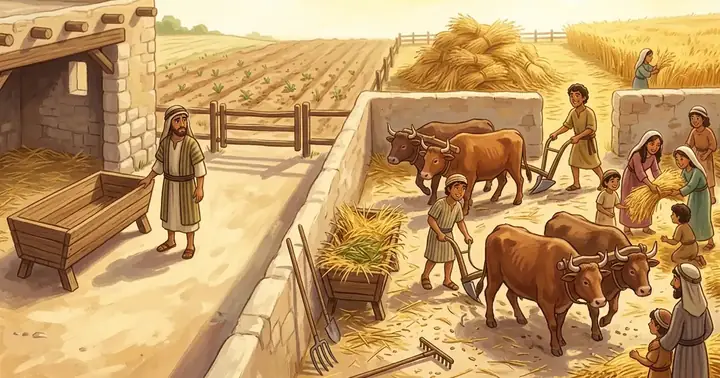
A manger was the trough or ledge where hay and grain were put out for oxen, donkeys and sheep. In a simple house of Bible times, the animals were often kept at one end of the main room, or in a cave beneath it, and the manger was cut into the rock or built against the wall. Proverbs notes that where there are no oxen the manger stays clean, but it is the ox that brings in the harvest (Proverbs 14:4).
The manger at Bethlehem
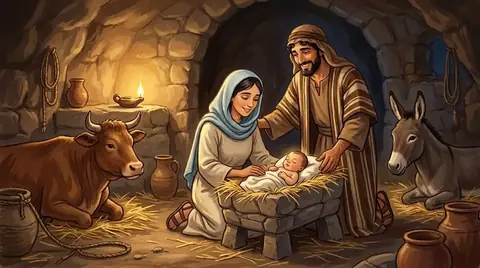
When Joseph and Mary came to Bethlehem, the lodging place was full. So the baby Jesus, wrapped in strips of cloth, was laid in a manger (Luke 2:7). The angels told the shepherds that this would be their sign: a baby lying in a feeding trough (Luke 2:12), and they hurried into town and found him there (Luke 2:16).
What it means
The King of heaven came into the world with no cradle but an animals' trough. From his first night, Jesus was poor and lowly, "meek and lowly in heart" (Matthew 11:29), and yet the whole of heaven sang over him. The manger reminds us that God's Son was born for the humble, not only for the great.
Key verses
- Luke 2:7
And she brought forth her firstborn son, and wrapped him in swaddling clothes, and laid him in a manger; because there was no room for them in the inn.
- Luke 2:12
And this shall be a sign unto you; Ye shall find the babe wrapped in swaddling clothes, lying in a manger.
- Luke 2:16
And they came with haste, and found Mary, and Joseph, and the babe lying in a manger.
- Luke 13:15
The Lord then answered him, and said, Thou hypocrite, doth not each one of you on the sabbath loose his ox or his ass from the stall, and lead him away to watering?
Read next
 PlaceBethlehemA small town in the hills of Judah, five miles south of Jerusalem. It was the home of Ruth and Boaz, the birthplace of…
 PersonJosephJacob's favourite son, sold by his brothers into Egypt, where he rose from prison to rule the land and saved his family…
 PersonMaryThe young woman of Nazareth chosen to be the mother of Jesus. She believed the angel's word, bore God's Son, and stood…
 Person · The Son of GodJesus ChristThe Son of God, born of the virgin Mary, who lived a sinless life, died on a cross for the sins of the world and rose…
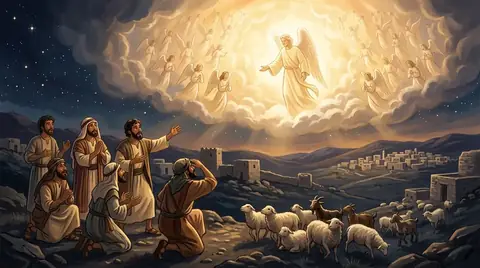 HeavenAngelsSpirits created by God to serve him and bring his messages; the word itself means "messenger". They are many, mighty…
 SymbolThe shepherdOne who leads, feeds, guards and seeks out the sheep. The Bible calls God the shepherd of his people, calls kings and…
Written for this app in its own words, from the Bible, with the facts checked against Bible dictionaries and encyclopedias: Easton's, Smith's, Fausset's, ISBE, Holman, the New Bible Dictionary, Vine's and the Thompson Chain topics.
