
Custom · Law
The kinsman-redeemer
Hebrew go'el, "one who buys back"
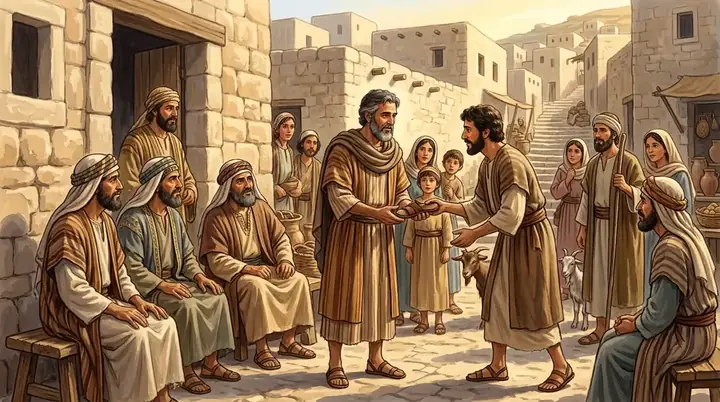
In Israel the nearest relative had the duty to rescue a relative in trouble: to buy back sold land, to free a kinsman sold as a slave, and to avenge his blood. Boaz did this for Ruth.
- Duties
- Buy back family land (Leviticus 25:25), free an enslaved relative (Leviticus 25:47–49), avenge a murder (Numbers 35:19), raise an heir for a dead brother (Ruth 4:5)
- Examples
- Boaz for Ruth and Naomi; Jeremiah buying his cousin's field (Jeremiah 32:6–15)
What it was
Every Israelite family had land that God had given it, and the law tried to keep land and family together. If a man fell into debt and had to sell his field, or even sell himself as a servant, his nearest male relative was expected to step in and buy it, or him, back (Leviticus 25:25, 47–49). The same relative, as "the avenger of blood", pursued the killer of a murdered kinsman (Numbers 35:19). And if a man died without a son, a kinsman might marry the widow so that the dead man's name and land went on (Deuteronomy 25:5–6). The redeemer had to be a blood relation, had to be able to pay, and had to be willing.
How it was used
The book of Ruth shows it in action. Naomi came home a widow with nothing but her foreign daughter-in-law and a field she could not farm. Boaz was a near kinsman. Ruth lay at his feet on the threshing floor and asked him to spread his cloak over her, "for thou art a near kinsman" (Ruth 3:9). There was a nearer relative, who was glad to buy the land until he learned that Ruth came with it; then he pulled off his sandal and gave up his right. Boaz bought the field, married Ruth, and their great-grandson was David (Ruth 4). Jeremiah, in a besieged city, bought his cousin's field at Anathoth as a sign that fields would one day be bought and sold again (Jeremiah 32).
Points to Christ
God calls himself Israel's Redeemer again and again in Isaiah, the kinsman who buys his people back from Babylon. Job cried, "I know that my redeemer liveth" (Job 19:25). Christians have always seen Jesus as the true kinsman-redeemer. He became our blood relation by taking flesh (Hebrews 2:14), he was able to pay, and he was willing: he bought us "not with corruptible things, as silver and gold, but with the precious blood of Christ" (1 Peter 1:18–19), and he takes the church as his bride.
Key verses
- Leviticus 25:25
If thy brother be waxen poor, and hath sold away some of his possession, and if any of his kin come to redeem it, then shall he redeem that which his brother sold.
- Ruth 3:9
And he said, Who art thou? And she answered, I am Ruth thine handmaid: spread therefore thy skirt over thine handmaid; for thou art a near kinsman.
- Ruth 4:9–10
And Boaz said unto the elders, and unto all the people, Ye are witnesses this day, that I have bought all that was Elimelech’s, and all that was Chilion’s and Mahlon’s, of the hand of Naomi. Moreover Ruth the Moabitess, the wife of Mahlon, have I purchased to be my wife, to raise up the name of the dead upon his inheritance, that the name of the dead be not cut off from among his brethren, and from the gate of his place: ye are witnesses this day.
- Job 19:25
For I know that my redeemer liveth, and that he shall stand at the latter day upon the earth:
- Isaiah 59:20
And the Redeemer shall come to Zion, and unto them that turn from transgression in Jacob, saith the Lord.
- 1 Peter 1:18–19
Forasmuch as ye know that ye were not redeemed with corruptible things, as silver and gold, from your vain conversation received by tradition from your fathers; But with the precious blood of Christ, as of a lamb without blemish and without spot:
Read next
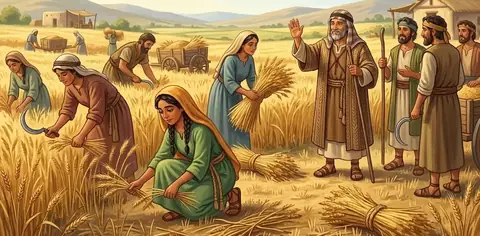 PersonBoazA wealthy farmer of Bethlehem who married Ruth, the Moabite widow, as her kinsman-redeemer. Their great-grandson was…
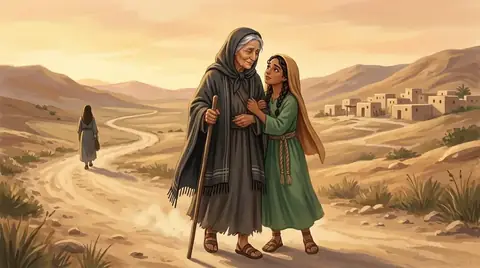 PersonRuthA young widow from Moab who left her own land to stay with her mother-in-law Naomi and trust Israel's God. She married…
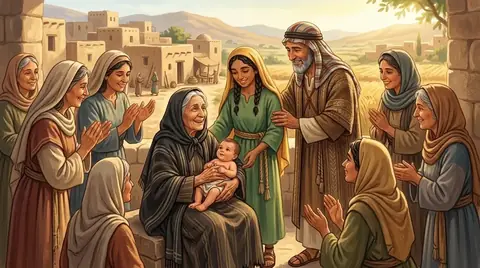 PersonNaomiA widow of Bethlehem who lost her husband and both sons in Moab, came home bitter and empty, and found through her…
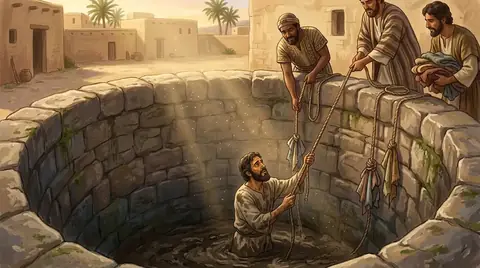 PersonJeremiahThe prophet who warned Judah for forty years that Babylon was coming, and wept as it came. He was beaten, put in the…
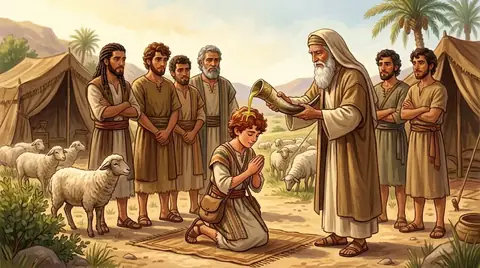 Person · KingDavidThe shepherd boy who killed Goliath and became Israel's greatest king, "a man after God's own heart". He wrote many…
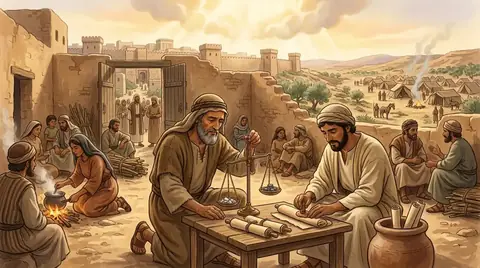 Place · TownAnathothA town of the priests in the land of Benjamin, about 3 miles north-east of Jerusalem, where the prophet Jeremiah was…
Written for this app in its own words, from the Bible, with the facts checked against Bible dictionaries and encyclopedias: Easton's, Smith's, Fausset's, ISBE, Holman, the New Bible Dictionary, Vine's and the Thompson Chain topics.
