
Name of God
Jehovah-tsidkenu (the LORD our righteousness)
je-HO-va tsid-KAY-noo
The name Jeremiah gives the coming King from David's line, the "righteous Branch". In days of corrupt rulers God promised a King who would be, in his own person, the righteousness of his people.
- Meaning
- The LORD our righteousness
- Where
- Jeremiah 23:6; Jeremiah 33:16
- Given by
- Jeremiah, of the promised King
The promise
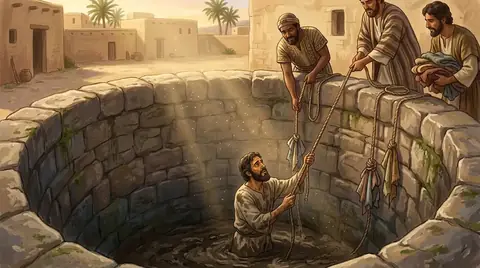
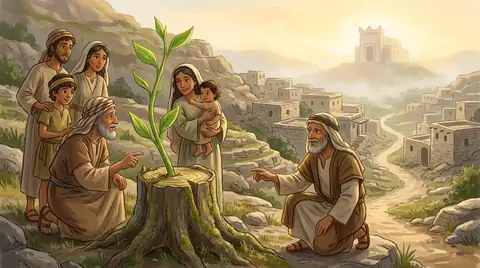
Jeremiah lived under the last kings of Judah, and most of them were rotten. God called them shepherds who scattered his flock (Jeremiah 23:1–2). Then came the promise: God would raise up for David "a righteous Branch", a King to rule with wisdom and to do what is just and right; under him Judah would be saved, and his name would be Jehovah-tsidkenu, "THE LORD OUR RIGHTEOUSNESS" (Jeremiah 23:5–6). Later the same name is given to the city where he reigns (Jeremiah 33:16).
What it means
Righteousness is being right with God, and the King would not only be righteous himself but would be righteousness for his people. They would not have to earn a standing with God; it would be given to them in him.
In Jesus
Jesus is the Branch from David's line (Matthew 1:1). Paul says that God has made Christ "unto us wisdom, and righteousness" (1 Corinthians 1:30), and that God made him who knew no sin to be sin for us, "that we might be made the righteousness of God in him" (2 Corinthians 5:21). Those who trust him are counted righteous for his sake, and his name is theirs: the LORD our righteousness.
Key verses
- Jeremiah 23:5–6
Behold, the days come, saith the Lord, that I will raise unto David a righteous Branch, and a King shall reign and prosper, and shall execute judgment and justice in the earth. In his days Judah shall be saved, and Israel shall dwell safely: and this is his name whereby he shall be called, THE LORD OUR RIGHTEOUSNESS.
- Jeremiah 33:16
In those days shall Judah be saved, and Jerusalem shall dwell safely: and this is the name wherewith she shall be called, The Lord our righteousness.
- 1 Corinthians 1:30
But of him are ye in Christ Jesus, who of God is made unto us wisdom, and righteousness, and sanctification, and redemption:
- 2 Corinthians 5:21
For he hath made him to be sin for us, who knew no sin; that we might be made the righteousness of God in him.
Read next
Written for this app in its own words, from the Bible, with the facts checked against Bible dictionaries and encyclopedias: Easton's, Smith's, Fausset's, ISBE, Holman, the New Bible Dictionary, Vine's and the Thompson Chain topics.
