
Name of God
Jehovah-nissi (the LORD is my banner)
je-HO-va NIS-see
Moses' name for the altar he raised when Israel defeated Amalek while his hands were lifted in prayer. A banner is the pole an army rallies round; the LORD himself was theirs.
- Meaning
- The LORD is my banner, my rallying standard
- Where
- Exodus 17:15
- Given by
- Moses, at Rephidim
- The battle
- Joshua's first, against Amalek (Exodus 17:8–13)
The story
Soon after the Red Sea, as Israel camped at Rephidim, the Amalekites attacked. Moses sent Joshua to fight and climbed a hill with the rod of God in his hand. While his hands stayed up, Israel had the better of it; whenever they sank, Amalek did. Aaron and Hur sat him on a stone and held up his arms, one on each side, until sunset, and Joshua defeated the enemy (Exodus 17:8–13).
The name
Moses built an altar and called it Jehovah-nissi. In ancient war a banner was not a flag but a tall pole with an emblem, planted where everyone could see it; scattered soldiers ran to it and fought under it. Moses' raised staff had been that pole, and the name says what it meant: the victory belonged to the LORD, and his people gather under him. God added a promise that he would fight Amalek "from generation to generation" (Exodus 17:14–16).
For us
Isaiah said that the "root of Jesse" would one day be raised as a banner, and the nations would flock to it (Isaiah 11:10), and Jesus said that when he was lifted up on the cross he would draw all people to himself (John 12:32). The story also shows how much the battle depends on prayer, and how much those who pray need friends to hold up their arms.
Key verses
- Exodus 17:8–16
Then came Amalek, and fought with Israel in Rephidim. And Moses said unto Joshua, Choose us out men, and go out, fight with Amalek: to morrow I will stand on the top of the hill with the rod of God in mine hand. So Joshua did as Moses had said to him, and fought with Amalek: and Moses, Aaron, and Hur went up to the top of the hill. …
- Isaiah 11:10
And in that day there shall be a root of Jesse, which shall stand for an ensign of the people; to it shall the Gentiles seek: and his rest shall be glorious.
- John 12:32
And I, if I be lifted up from the earth, will draw all men unto me.
Read next
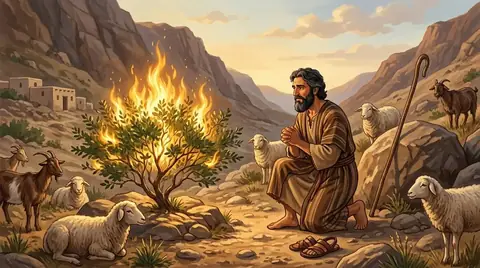 PersonMosesThe man God used to bring Israel out of Egypt, give them his Law at Sinai, and lead them for forty years in the…
 PersonJoshuaMoses' helper who took over from him and led Israel across the Jordan into the Promised Land. He fought the wars of…
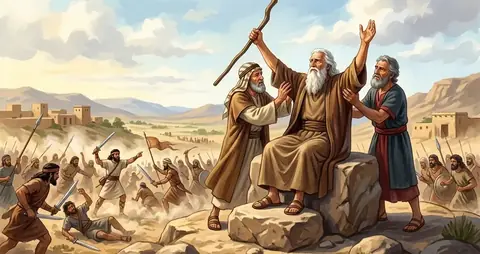 Person · NationAmalekThe grandson of Esau and the desert tribe descended from him, Israel's bitter enemy. The Amalekites attacked Israel on…
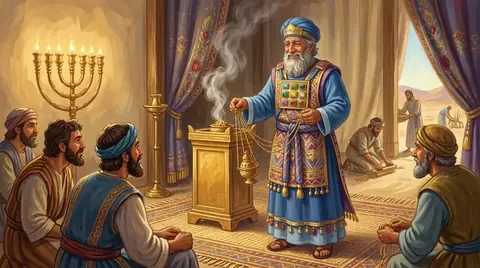 PersonAaronMoses' older brother and Israel's first high priest. He spoke for Moses before Pharaoh and served God at the tabernacle…
Written for this app in its own words, from the Bible, with the facts checked against Bible dictionaries and encyclopedias: Easton's, Smith's, Fausset's, ISBE, Holman, the New Bible Dictionary, Vine's and the Thompson Chain topics.
