
Thing · Temple
Jachin and Boaz
JAY-kin, BO-az
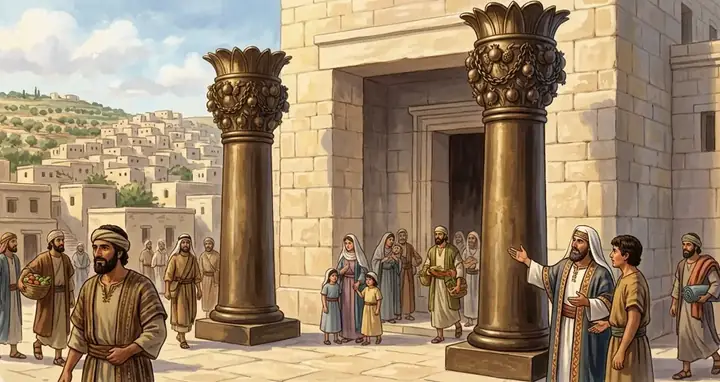
The two huge bronze pillars that stood at the entrance of Solomon's temple, each with a name: Jachin, "he will establish", and Boaz, "in him is strength".
- Size
- 18 cubits high, about 27 feet (8 m), and 12 cubits round, with capitals 5 cubits high (1 Kings 7:15–16)
- Made by
- Hiram of Tyre, cast in clay moulds in the Jordan valley (1 Kings 7:13–14; 1 Kings 7:46)
- Decorated with
- Lily work, chains of network and two hundred pomegranates on each capital (1 Kings 7:17–22)
- Fate
- Broken up by the Babylonians in 586 BC and carried away (2 Kings 25:13)
What they were
Solomon brought a craftsman from Tyre, Hiram, a widow's son skilled in bronze, and his first work was the two pillars for the porch of the temple. Each was hollow, about four fingers thick, 27 feet (8 m) tall, and so wide that it took a line of 18 feet (5.5 m) to go round it. On top sat a capital shaped like a bowl or lily, hung with chains of net-work and two rows of bronze pomegranates (1 Kings 7:15–22; Jeremiah 52:21–23). Whether they held up the roof of the porch or stood free isn't certain; they seem to have stood free, on either side of the doorway.
What they meant
Solomon named them. The right-hand pillar was Jachin, "he establishes", and the left Boaz, "in him is strength" (1 Kings 7:21; 2 Chronicles 3:17). Everyone who went up to worship passed between two promises: God will make this house and this kingdom firm, and its strength is in him. Kings may have stood by a pillar at great moments; Josiah renewed the covenant standing "by a pillar" (2 Kings 23:3).
Their end
When Nebuchadnezzar burned the temple, his soldiers broke the pillars in pieces and carried the bronze off to Babylon, and Jeremiah, listing the loss, says their weight was beyond reckoning (2 Kings 25:13; Jeremiah 52:17–20). In Revelation Jesus promises the one who overcomes that he will make him "a pillar in the temple of my God", never to leave it (Revelation 3:12).
Key verses
- 1 Kings 7:15–22
For he cast two pillars of brass, of eighteen cubits high apiece: and a line of twelve cubits did compass either of them about. And he made two chapiters of molten brass, to set upon the tops of the pillars: the height of the one chapiter was five cubits, and the height of the other chapiter was five cubits: And nets of checker work, and wreaths of chain work, for the chapiters which were upon the top of the pillars; seven for the one chapiter, and seven for the other chapiter. …
- 2 Chronicles 3:15–17
Also he made before the house two pillars of thirty and five cubits high, and the chapiter that was on the top of each of them was five cubits. And he made chains, as in the oracle, and put them on the heads of the pillars; and made an hundred pomegranates, and put them on the chains. And he reared up the pillars before the temple, one on the right hand, and the other on the left; and called the name of that on the right hand Jachin, and the name of that on the left Boaz.
- 2 Kings 25:13
And the pillars of brass that were in the house of the Lord, and the bases, and the brasen sea that was in the house of the Lord, did the Chaldees break in pieces, and carried the brass of them to Babylon.
- Revelation 3:12
Him that overcometh will I make a pillar in the temple of my God, and he shall go no more out: and I will write upon him the name of my God, and the name of the city of my God, which is new Jerusalem, which cometh down out of heaven from my God: and I will write upon him my new name.
Read next
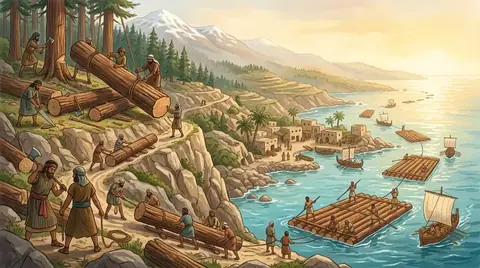 Person · KingHiramThe king of Tyre who was a friend to David and Solomon, sending cedar from Lebanon and skilled workmen for David's…
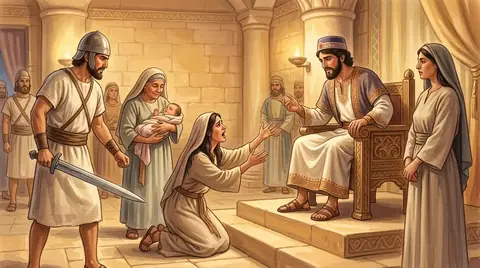 Person · KingSolomonDavid's son and Israel's third king, who asked God for wisdom and received riches and fame as well. He built the temple…
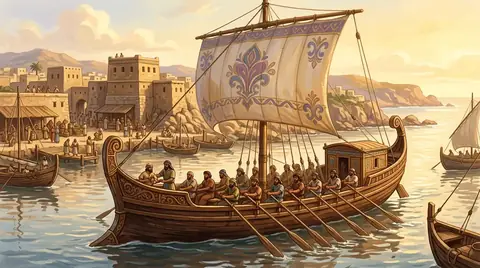 Place · CityTyreThe great trading port of Phoenicia, on the coast north of Israel. Its king Hiram helped build Solomon's temple; later…
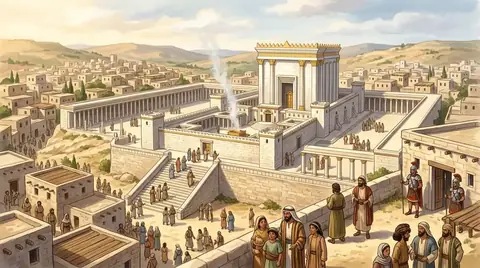 Thing · WorshipThe TempleGod's house in Jerusalem, where he was worshipped and the sacrifices offered. Solomon built it, Babylon burned it, the…
 Plant · FruitPomegranateA round red fruit packed with juicy seeds, grown all over the Bible lands. Its shape hung in blue, purple and scarlet…
 PersonJosiahThe boy king of Judah who turned the nation back to God. When the lost Book of the Law was found in the temple, he tore…
 Place · CityBabylonThe great city on the Euphrates where the tower of Babel was built. Under Nebuchadnezzar it ruled the world, destroyed…TeachingRevelationGod uncovering what we could never find out for ourselves: who he is, what he has done, and what he wants. He has done…
Written for this app in its own words, from the Bible, with the facts checked against Bible dictionaries and encyclopedias: Easton's, Smith's, Fausset's, ISBE, Holman, the New Bible Dictionary, Vine's and the Thompson Chain topics.
