
Custom · Worship
The grain offering
KJV "meat offering", when meat meant food
A gift of fine wheat flour mixed with olive oil and frankincense, sometimes baked as cakes. The priest burned one handful on the altar and ate the rest. It thanked God for daily bread.
- Made of
- Fine flour, olive oil, frankincense and salt; never yeast or honey (Leviticus 2:11–13)
- Forms
- Raw flour, or baked in an oven, on a griddle or in a pan (Leviticus 2:1–7)
- Shared
- A memorial handful burned; the rest eaten by the priests (Leviticus 2:2–3)
- With
- The daily lambs and other burnt offerings (Numbers 28:5; Numbers 15:1–12)
What it was
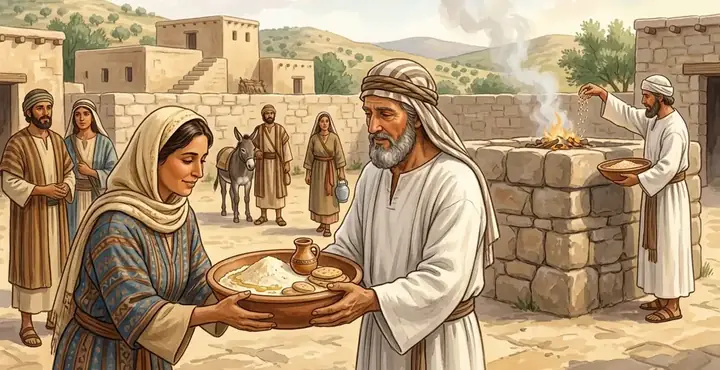
Every other offering in Leviticus was an animal; this one was the fruit of the field. The worshipper brought fine wheat flour mixed with olive oil, and the priest burned a handful of it with all the frankincense as "a memorial", a sweet smell to the LORD. What was left was "a thing most holy" for Aaron and his sons to eat in the holy place (Leviticus 2:1–3; Leviticus 6:14–18). It could also be brought baked: cakes from the oven, wafers from a griddle, or dough fried in a pan (Leviticus 2:4–7). No yeast or honey could go on the altar, both of them agents of fermentation, but every offering had to have salt, "the salt of the covenant" (Leviticus 2:11–13). The KJV calls it the meat offering because in 1611 meat meant any food.
When it was brought
A grain offering went with the lamb every morning and evening, and with every burnt and peace offering, along with wine to pour out (Numbers 15:1–12; Numbers 28:3–8). At the start of harvest the first sheaf came as grain in the ear, parched and crushed (Leviticus 2:14; Leviticus 23:10–13). A poor man who could not afford even two birds for his sin offering might bring flour instead, without oil or frankincense (Leviticus 5:11–13).
What it meant
Flour, oil and wine were the daily food of Israel. To give the best of them back to God was to say that the harvest was his gift and the giver was his. It also fed the priests, who had no land of their own. Jesus, who taught us to pray for daily bread, called himself the bread of life (John 6:35), and Paul speaks of his own life being poured out like the drink offering that went with it (Philippians 2:17).
Key verses
- Leviticus 2:1–3
And when any will offer a meat offering unto the Lord, his offering shall be of fine flour; and he shall pour oil upon it, and put frankincense thereon: And he shall bring it to Aaron’s sons the priests: and he shall take thereout his handful of the flour thereof, and of the oil thereof, with all the frankincense thereof; and the priest shall burn the memorial of it upon the altar, to be an offering made by fire, of a sweet savour unto the Lord: And the remnant of the meat offering shall be Aaron’s and his sons’: it is a thing most holy of the offerings of the Lord made by fire.
- Leviticus 2:11–13
No meat offering, which ye shall bring unto the Lord, shall be made with leaven: for ye shall burn no leaven, nor any honey, in any offering of the Lord made by fire. As for the oblation of the firstfruits, ye shall offer them unto the Lord: but they shall not be burnt on the altar for a sweet savour. And every oblation of thy meat offering shalt thou season with salt; neither shalt thou suffer the salt of the covenant of thy God to be lacking from thy meat offering: with all thine offerings thou shalt offer salt.
- Leviticus 6:14–18
And this is the law of the meat offering: the sons of Aaron shall offer it before the Lord, before the altar. And he shall take of it his handful, of the flour of the meat offering, and of the oil thereof, and all the frankincense which is upon the meat offering, and shall burn it upon the altar for a sweet savour, even the memorial of it, unto the Lord. And the remainder thereof shall Aaron and his sons eat: with unleavened bread shall it be eaten in the holy place; in the court of the tabernacle of the congregation they shall eat it. …
- Numbers 28:5
And a tenth part of an ephah of flour for a meat offering, mingled with the fourth part of an hin of beaten oil.
- Leviticus 23:10–13
Speak unto the children of Israel, and say unto them, When ye be come into the land which I give unto you, and shall reap the harvest thereof, then ye shall bring a sheaf of the firstfruits of your harvest unto the priest: And he shall wave the sheaf before the Lord, to be accepted for you: on the morrow after the sabbath the priest shall wave it. And ye shall offer that day when ye wave the sheaf an he lamb without blemish of the first year for a burnt offering unto the Lord. …
Read next
Written for this app in its own words, from the Bible, with the facts checked against Bible dictionaries and encyclopedias: Easton's, Smith's, Fausset's, ISBE, Holman, the New Bible Dictionary, Vine's and the Thompson Chain topics.
