
Custom · Worship
Frontlets
Also called phylacteries
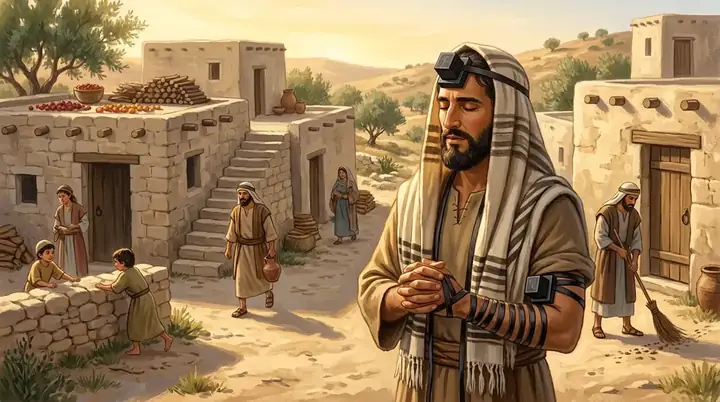
God told Israel to bind his words on their hands and wear them "as frontlets between thine eyes". Later Jews took this literally and wore small leather boxes holding verses of the law on the forehead and arm at prayer. Jesus rebuked the Pharisees for making theirs big to be seen.
- Where
- Exodus 13:9, 16; Deuteronomy 6:8; Deuteronomy 11:18; Matthew 23:5 ("phylacteries")
- Inside
- Exodus 13:1–10; Exodus 13:11–16; Deuteronomy 6:4–9; Deuteronomy 11:13–21, written on parchment
What God said
Three times the law says that God's words were to be "a sign upon thine hand, and as frontlets between thine eyes" (Exodus 13:16; Deuteronomy 6:8; Deuteronomy 11:18). Along with the command to write them on the doorposts, the point was that his words should be always before the eyes and always in the hand: remembered in everything they looked at and everything they did. Proverbs speaks the same way of binding a father's teaching on the fingers and writing it on the heart (Proverbs 7:3).
What it became
From some time after the exile, Jews took the words literally. Four passages of the law were written on strips of parchment and put in small leather boxes, one tied to the forehead with a strap and another to the left arm, near the heart, during morning prayer. In Hebrew they are tefillin, "prayers"; the Greek name phylacteries means "guards", as if they protected the wearer. The custom is still kept by observant Jews. Jesus did not condemn the practice, but he did condemn its show: the Pharisees "make broad their phylacteries", widening the straps and boxes so that everyone could see how devout they were (Matthew 23:5). The sign on the hand was never meant to be seen by others; it was meant to shape the one who wore it.
Key verses
- Deuteronomy 6:6–8
And these words, which I command thee this day, shall be in thine heart: And thou shalt teach them diligently unto thy children, and shalt talk of them when thou sittest in thine house, and when thou walkest by the way, and when thou liest down, and when thou risest up. And thou shalt bind them for a sign upon thine hand, and they shall be as frontlets between thine eyes.
- Exodus 13:16
And it shall be for a token upon thine hand, and for frontlets between thine eyes: for by strength of hand the Lord brought us forth out of Egypt.
- Deuteronomy 11:18
Therefore shall ye lay up these my words in your heart and in your soul, and bind them for a sign upon your hand, that they may be as frontlets between your eyes.
- Matthew 23:5
But all their works they do for to be seen of men: they make broad their phylacteries, and enlarge the borders of their garments,
Written for this app in its own words, from the Bible, with the facts checked against Bible dictionaries and encyclopedias: Easton's, Smith's, Fausset's, ISBE, Holman, the New Bible Dictionary, Vine's and the Thompson Chain topics.
