
Animal · Insect
Fly
Also called flies
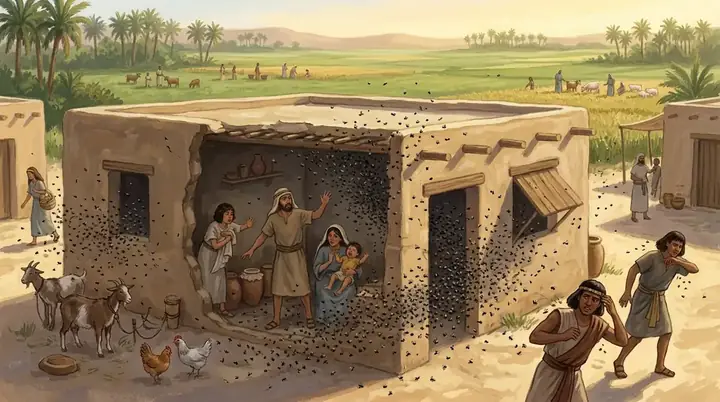
Swarms of biting flies were the fourth plague on Egypt, filling every house but sparing Goshen. Flies were such a pest in the East that the Philistines had a god, Baal-zebub, "lord of flies", and dead flies spoil the perfumer's ointment.
- Hebrew
- arob, the swarm of the plague (Exodus 8:21); zebub, the common fly (Ecclesiastes 10:1; Isaiah 7:18)
- Where
- Exodus 8:21–31; Psalms 78:45; Psalms 105:31; Ecclesiastes 10:1; Isaiah 7:18
The plague
After the gnats, God sent "swarms of flies" on Egypt (Exodus 8:21–24). They filled Pharaoh's palace and every house, and the land was ruined by them; but in Goshen, where Israel lived, there were none, so that everyone could see whose hand it was. The Hebrew does not name the insect. Old Jewish teachers thought it meant a mixture of creatures; others a biting fly like the dog-fly or a stinging beetle. The psalmist says God "sent divers sorts of flies among them, which devoured them" (Psalms 78:45). Pharaoh begged for relief and then hardened his heart again.
Elsewhere in the Bible
The ordinary fly was so troublesome that the Philistines of Ekron worshipped Baal-zebub, the "lord of flies", as the god who could drive them off (2 Kings 1:2). Isaiah warned that God would whistle for the fly of Egypt and the bee of Assyria, two armies that would settle on the land like insects (Isaiah 7:18). The Preacher observes that "dead flies cause the ointment of the apothecary to send forth a stinking savour", and that a little folly spoils a wise man's good name in the same way (Ecclesiastes 10:1).
Key verses
- Exodus 8:21–24
Else, if thou wilt not let my people go, behold, I will send swarms of flies upon thee, and upon thy servants, and upon thy people, and into thy houses: and the houses of the Egyptians shall be full of swarms of flies, and also the ground whereon they are. And I will sever in that day the land of Goshen, in which my people dwell, that no swarms of flies shall be there; to the end thou mayest know that I am the Lord in the midst of the earth. And I will put a division between my people and thy people: to morrow shall this sign be. …
- Psalms 105:31
He spake, and there came divers sorts of flies, and lice in all their coasts.
- Ecclesiastes 10:1
Dead flies cause the ointment of the apothecary to send forth a stinking savour: so doth a little folly him that is in reputation for wisdom and honour.
- Isaiah 7:18
And it shall come to pass in that day, that the Lord shall hiss for the fly that is in the uttermost part of the rivers of Egypt, and for the bee that is in the land of Assyria.
Read next
Written for this app in its own words, from the Bible, with the facts checked against Bible dictionaries and encyclopedias: Easton's, Smith's, Fausset's, ISBE, Holman, the New Bible Dictionary, Vine's and the Thompson Chain topics.
