
Symbol · Plant
The fig tree
A picture of Israel, expected to bear fruit for God
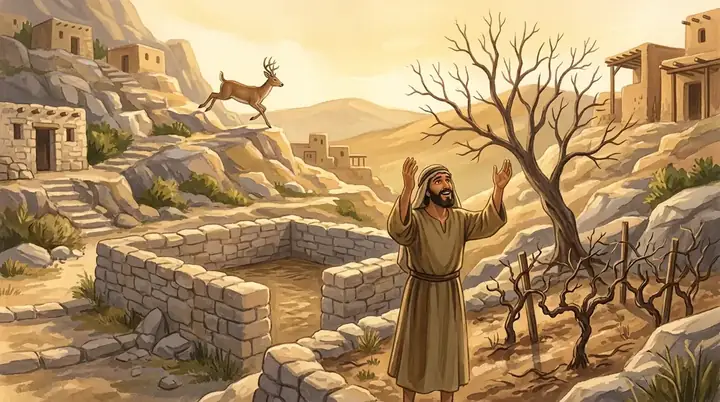
In the prophets and in Jesus' teaching the fig tree stands for Israel, planted by God to bear fruit. Jesus cursed a leafy tree with no figs and told of a barren tree given one more year, warnings of judgment on fruitless religion.
- In the prophets
- Hosea 9:10; Jeremiah 8:13; Jeremiah 24; Joel 1:7
- In Jesus
- The barren fig tree (Luke 13:6–9); the cursed fig tree (Mark 11:12–21); the lesson of the fig tree (Matthew 24:32)
- Peace
- "Every man under his fig tree" (Micah 4:4; Zechariah 3:10)
In the Old Testament
God said that when he found Israel it was like finding the first ripe figs on a fig tree (Hosea 9:10). But when he came looking for fruit there were "no figs on the fig tree" (Jeremiah 8:13), and a locust army stripped its bark white (Joel 1:7). The nation under its vine and fig tree was the picture of peace in Solomon's day and of the coming kingdom (1 Kings 4:25; Micah 4:4). Habakkuk learned to rejoice in God even when the fig tree did not blossom (Habakkuk 3:17–18). In Jotham's fable the fig tree refused to leave its sweetness to rule over the trees (Judges 9:10–11).
In Jesus' teaching
Jesus told of a man who came three years running to a fig tree in his vineyard and found nothing; the gardener begged one more year of digging and manure before it was cut down (Luke 13:6–9). It was a parable of Israel in Jesus' ministry, and of every life given time to repent. On the Monday of his last week he came to a fig tree in full leaf, found no fruit, and said, "No man eat fruit of thee hereafter for ever"; by the next morning it had withered from the roots (Mark 11:12–21). It was his only miracle of judgment, done the day he cleared the temple, and it said the same thing: a show of leaves without fruit would not be spared. He also drew a hopeful lesson: as the fig tree's soft shoots tell you summer is near, the signs he gave would tell his disciples that his coming was near (Matthew 24:32–33).
For us
God looks for fruit, not leaves: a changed life, not religious show (Matthew 7:16–20). He is patient, but not for ever. The lesson of the fig tree is to use the extra year.
Key verses
- Hosea 9:10
I found Israel like grapes in the wilderness; I saw your fathers as the firstripe in the fig tree at her first time: but they went to Baal–peor, and separated themselves unto that shame; and their abominations were according as they loved.
- Luke 13:6–9
He spake also this parable; A certain man had a fig tree planted in his vineyard; and he came and sought fruit thereon, and found none. Then said he unto the dresser of his vineyard, Behold, these three years I come seeking fruit on this fig tree, and find none: cut it down; why cumbereth it the ground? And he answering said unto him, Lord, let it alone this year also, till I shall dig about it, and dung it: …
- Mark 11:13–14
And seeing a fig tree afar off having leaves, he came, if haply he might find any thing thereon: and when he came to it, he found nothing but leaves; for the time of figs was not yet. And Jesus answered and said unto it, No man eat fruit of thee hereafter for ever. And his disciples heard it.
- Matthew 24:32
Now learn a parable of the fig tree; When his branch is yet tender, and putteth forth leaves, ye know that summer is nigh:
- Micah 4:4
But they shall sit every man under his vine and under his fig tree; and none shall make them afraid: for the mouth of the Lord of hosts hath spoken it.
Read next
Written for this app in its own words, from the Bible, with the facts checked against Bible dictionaries and encyclopedias: Easton's, Smith's, Fausset's, ISBE, Holman, the New Bible Dictionary, Vine's and the Thompson Chain topics.
