
Symbol
Colours: white
Purity, holiness and victory
The colour of light, clean linen and snow. White stands for purity and holiness, for the glory of Christ at the transfiguration and the throne, and for the victory and joy of his people.
- Christ
- His clothes shone white on the mountain (Matthew 17:2); his hair white as wool (Revelation 1:14)
- God's people
- Washed white in the Lamb's blood (Revelation 7:14); the bride in clean white linen (Revelation 19:8)
- Victory
- The rider on the white horse (Revelation 6:2; Revelation 19:11); the great white throne (Revelation 20:11)
- Also
- Whitewashed tombs, clean outside and foul within (Matthew 23:27)
Purity
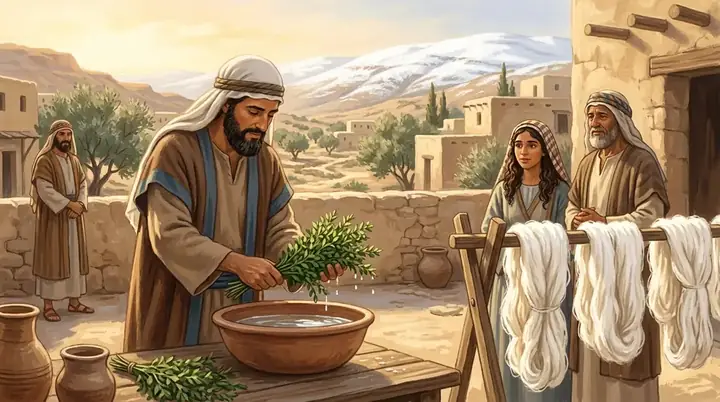
David prays, "Wash me, and I shall be whiter than snow" (Psalms 51:7), and God promises that sins as red as scarlet "shall be as white as snow" (Isaiah 1:18). White is what is left when every stain is gone. The priests served in white linen, and on the Day of Atonement the high priest put aside his coloured robes for plain white to go into the Most Holy Place (Leviticus 16:4). Ecclesiastes advises, "Let thy garments be always white" (Ecclesiastes 9:8), a life kept clean and glad.
Glory
When Jesus was transfigured his face shone like the sun and his clothes became white as light, whiter than any bleacher on earth could make them (Matthew 17:2; Mark 9:3). The angel at his tomb had clothing white as snow (Matthew 28:3). Daniel saw the Ancient of Days with a garment white as snow and hair like pure wool (Daniel 7:9), and John saw the risen Christ the same way (Revelation 1:14). White is the colour of heaven's light breaking through.
Victory and joy
In Revelation white is everywhere among the saved: white robes for the overcomers and the martyrs (Revelation 3:4–5; Revelation 6:11), white garments on the twenty-four elders (Revelation 4:4), a great crowd in white robes that have been washed in the blood of the Lamb (Revelation 7:9–14), the bride dressed in fine linen, "the righteousness of saints" (Revelation 19:8), a white stone with a new name on it (Revelation 2:17). Christ rides out on a white horse to conquer (Revelation 19:11–14), and judgment is given from "a great white throne" (Revelation 20:11).
A warning
White can also be a coat of paint. Jesus called the Pharisees "whited sepulchres", beautiful outside and full of dead men's bones within (Matthew 23:27). He advises the lukewarm church to buy from him "white raiment", because its own clothes were not clean (Revelation 3:18).
Key verses
- Isaiah 1:18
Come now, and let us reason together, saith the Lord: though your sins be as scarlet, they shall be as white as snow; though they be red like crimson, they shall be as wool.
- Psalms 51:7
Purge me with hyssop, and I shall be clean: wash me, and I shall be whiter than snow.
- Matthew 17:2
And was transfigured before them: and his face did shine as the sun, and his raiment was white as the light.
- Revelation 7:14
And I said unto him, Sir, thou knowest. And he said to me, These are they which came out of great tribulation, and have washed their robes, and made them white in the blood of the Lamb.
- Revelation 19:8
And to her was granted that she should be arrayed in fine linen, clean and white: for the fine linen is the righteousness of saints.
- Revelation 20:11
And I saw a great white throne, and him that sat on it, from whose face the earth and the heaven fled away; and there was found no place for them.
Read next
Written for this app in its own words, from the Bible, with the facts checked against Bible dictionaries and encyclopedias: Easton's, Smith's, Fausset's, ISBE, Holman, the New Bible Dictionary, Vine's and the Thompson Chain topics.
