
Place · Town
Baal-gad
BAY-al GADOld Testament · at the foot of Mount Hermon · the northern limit of Joshua's conquest · the site isn't certain
A Canaanite town in the valley of Lebanon below Mount Hermon, the furthest point north that Joshua's conquests reached. Its name probably comes from the worship of Baal there.
- Where
- "In the valley of Lebanon under mount Hermon" (Joshua 11:17); perhaps near Banias, by the springs of the Jordan
- Known for
- The northern edge of Joshua's conquest (Joshua 12:7)
- Meaning
- Baal of fortune, or lord of fortune
- Perhaps the same as
- Baal-hermon (Judges 3:3; 1 Chronicles 5:23)
When the book of Joshua sums up the conquest, it marks out the land from south to north: from Mount Halak, which rises towards Seir, "even unto Baal-gad in the valley of Lebanon under mount Hermon" (Joshua 11:17; Joshua 12:7). Baal-gad was the northern limit. Beyond it lay land God had promised but Israel had not yet taken, "from Baal-gad under mount Hermon unto the entering into Hamath" (Joshua 13:5).
The town stood at the foot of Mount Hermon, in the valley between the Lebanon ranges. Many place it near Banias, the later Caesarea Philippi, by the great spring of the Jordan; others suggest sites further north. As its name shows, Baal was worshipped there, a reminder of how much of the land still needed to be turned to the true God.
Key verses
- Joshua 11:17
Even from the mount Halak, that goeth up to Seir, even unto Baal–gad in the valley of Lebanon under mount Hermon: and all their kings he took, and smote them, and slew them.
- Joshua 12:7
And these are the kings of the country which Joshua and the children of Israel smote on this side Jordan on the west, from Baal–gad in the valley of Lebanon even unto the mount Halak, that goeth up to Seir; which Joshua gave unto the tribes of Israel for a possession according to their divisions;
- Joshua 13:5
And the land of the Giblites, and all Lebanon, toward the sunrising, from Baal–gad under mount Hermon unto the entering into Hamath.
Read next
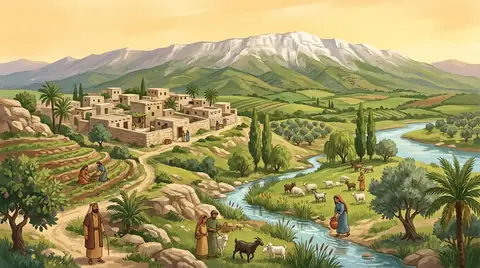 Place · MountainMount HermonThe highest mountain in the region, over 9,000 feet (2,800 m), at the far north of Israel. Its snows feed the Jordan…
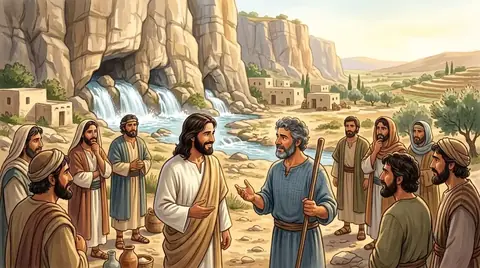 Place · CityCaesarea PhilippiA town in the far north of the Holy Land, at the springs of the Jordan. Near here Peter declared that Jesus is the…
Written for this app in its own words, from the Bible, with the facts checked against Bible dictionaries and encyclopedias: Easton's, Smith's, Fausset's, ISBE, Holman, the New Bible Dictionary, Vine's and the Thompson Chain topics.
