
Person
Antiochus
an-TYE-o-kusBetween the Testaments · kings of Syria, about 280–65 BC
The name of many Greek kings of Syria after Alexander. The best known, Antiochus Epiphanes, tried to stamp out the Jewish faith and defiled the temple, as Daniel had foretold.
- Known for
- The "king of the north" in Daniel 11
- Family
- The Seleucid kings, rulers of Syria after Alexander the Great
Who they were
When Alexander the Great died, one of his generals, Seleucus, took Syria and the lands to the east. Many of his family were named Antiochus. They are not named in the Bible, but Daniel 11 traces their wars with the kings of Egypt, "the king of the north" against "the king of the south".
Antiochus the Great
Antiochus III took the Holy Land from Egypt about 198 BC. The traditional reading sees him in the king of the north who stands "in the glorious land" but at last stumbles and falls (Daniel 11:13–19).
Antiochus Epiphanes
His son, Antiochus IV, called himself Epiphanes, "God made visible". Daniel describes a "vile person" who would take the kingdom by flatteries, turn against the holy covenant, stop the daily sacrifice and set up "the abomination that maketh desolate" (Daniel 11:21; Daniel 11:28–31). About 167 BC he forbade the Jewish faith and set up a pagan altar in the temple. Faithful Jews rose up under the Maccabees, and in 164 BC they cleansed the temple, remembered at the Feast of Dedication (John 10:22). He died that same year.
For us
Daniel had said that "the people that do know their God shall be strong" (Daniel 11:32). Jesus pointed to that abomination as a picture of a desolation still to come (Matthew 24:15).
Key verses
- Daniel 11:21
And in his estate shall stand up a vile person, to whom they shall not give the honour of the kingdom: but he shall come in peaceably, and obtain the kingdom by flatteries.
- Daniel 11:31–32
And arms shall stand on his part, and they shall pollute the sanctuary of strength, and shall take away the daily sacrifice, and they shall place the abomination that maketh desolate. And such as do wickedly against the covenant shall he corrupt by flatteries: but the people that do know their God shall be strong, and do exploits.
- Daniel 8:23–25
And in the latter time of their kingdom, when the transgressors are come to the full, a king of fierce countenance, and understanding dark sentences, shall stand up. And his power shall be mighty, but not by his own power: and he shall destroy wonderfully, and shall prosper, and practise, and shall destroy the mighty and the holy people. And through his policy also he shall cause craft to prosper in his hand; and he shall magnify himself in his heart, and by peace shall destroy many: he shall also stand up against the Prince of princes; but he shall be broken without hand.
- John 10:22
And it was at Jerusalem the feast of the dedication, and it was winter.
Read next
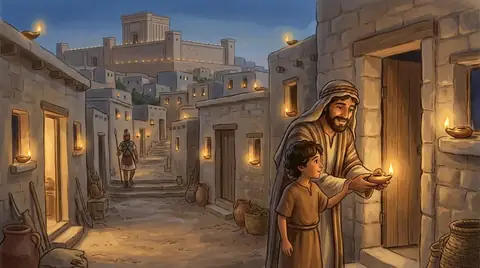 FeastThe Feast of Dedication (Hanukkah)The winter feast that remembers how the temple was cleansed in 164 BC after Judas Maccabeus drove out the Greeks who…
Written for this app in its own words, from the Bible, with the facts checked against Bible dictionaries and encyclopedias: Easton's, Smith's, Fausset's, ISBE, Holman, the New Bible Dictionary, Vine's and the Thompson Chain topics. Also: 1 Maccabees; Josephus, Antiquities.
