
Nature · Lesson
Ant, bee and spider (Proverbs' small teachers)
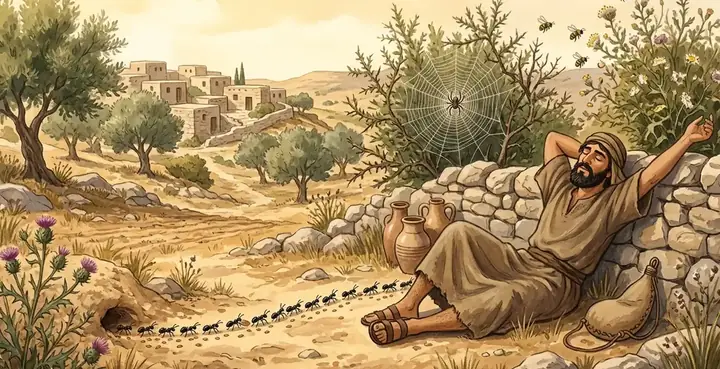
Tiny creatures that carry big lessons in the Bible: the ant's hard work, the bee's sting and sweetness, the spider's flimsy web, the moth that eats treasure and the worm that never dies.
- Ant
- Hard work and foresight (Proverbs 6:6–8; Proverbs 30:25)
- Bee
- A fierce enemy and sweet honey (Deuteronomy 1:44; Judges 14:8)
- Spider
- A web that cannot hold you up (Job 8:14; Isaiah 59:5)
- Moth and worm
- Decay and judgment (Matthew 6:19–20; Mark 9:48)
The ant
Proverbs sends the lazy man to the ant. She has no captain or ruler, yet she gathers her food in summer and stores it for winter (Proverbs 6:6–8). Agur lists ants among "four things which are little upon the earth, but they are exceeding wise" (Proverbs 30:24–25). Foresight does not need size.
The bee
In the Bible the bee is first of all a fighter. The Amorites chased Israel "as bees do" (Deuteronomy 1:44), and the psalmist's enemies swarmed around him in the same way (Psalms 118:12). God promised to send the hornet ahead of Israel into Canaan (Deuteronomy 7:20). Yet bees also give honey, the sweetest thing the ancient world knew. Samson found a swarm and a honeycomb inside the carcass of the lion he had killed, and it became a riddle: "out of the strong came forth sweetness" (Judges 14:8–14).
The spider
The spider's web looks like a house, but lean on it and it gives way. Bildad says that is what the hope of a man who forgets God is like (Job 8:14), and Isaiah says the schemes of the wicked are spider's webs that will never make clothing (Isaiah 59:5–6). Agur, though, admires the little creature that lives in kings' palaces (Proverbs 30:28).
The moth and the worm
The moth that eats cloth is the Bible's picture of how earthly wealth rots away. Lay up treasure in heaven, Jesus said, "where neither moth nor rust doth corrupt" (Matthew 6:19–20; James 5:2; Isaiah 51:8). The worm that eats the dead is a picture of judgment: Jesus warned of the place where "their worm dieth not, and the fire is not quenched" (Mark 9:48), and Herod Agrippa, who took the glory that belonged to God, was eaten of worms and died (Acts 12:23).
The lesson
God teaches through the smallest of his creatures. Job told his friends, "ask now the beasts, and they shall teach thee" (Job 12:7). The one who looks closely at the world God made will not go without a lesson.
Key verses
- Proverbs 6:6–8
Go to the ant, thou sluggard; consider her ways, and be wise: Which having no guide, overseer, or ruler, Provideth her meat in the summer, and gathereth her food in the harvest.
- Proverbs 30:24–28
There be four things which are little upon the earth, but they are exceeding wise: The ants are a people not strong, yet they prepare their meat in the summer; The conies are but a feeble folk, yet make they their houses in the rocks; …
- Judges 14:8
And after a time he returned to take her, and he turned aside to see the carcase of the lion: and, behold, there was a swarm of bees and honey in the carcase of the lion.
- Job 8:14
Whose hope shall be cut off, and whose trust shall be a spider’s web.
- Matthew 6:19–20
Lay not up for yourselves treasures upon earth, where moth and rust doth corrupt, and where thieves break through and steal: But lay up for yourselves treasures in heaven, where neither moth nor rust doth corrupt, and where thieves do not break through nor steal:
- Mark 9:48
Where their worm dieth not, and the fire is not quenched.
Read next
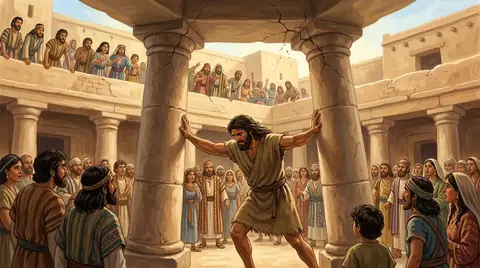 Person · JudgeSamsonThe judge of Israel with superhuman strength from God, a Nazirite from birth. He fought the Philistines single-handed…
Written for this app in its own words, from the Bible, with the facts checked against Bible dictionaries and encyclopedias: Easton's, Smith's, Fausset's, ISBE, Holman, the New Bible Dictionary, Vine's and the Thompson Chain topics.
